
A supplier capability audit should determine how much sampling, pilot production, capacity protection, and bulk inspection an order requires. The audit is useful only when its findings are converted into controls for the specific fabric construction, color, finish, subcontracted process, volume, and delivery plan—not when it produces a generic approved-supplier score.
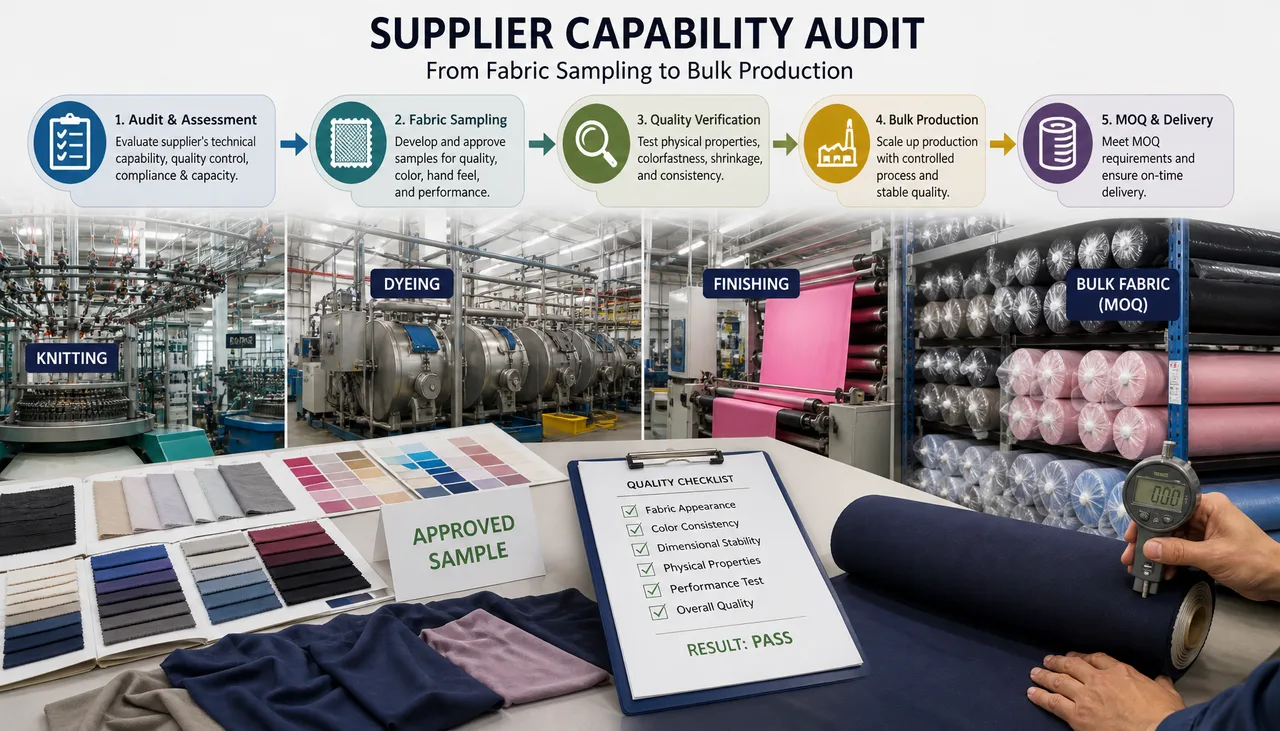
Audit the production route for the specific order
Map every material and process that can change the finished fabric: yarn sourcing, knitting, dyeing, heat setting, printing where applicable, functional finishing, inspection, testing, packing, and shipment release. Record which party performs each step and which operations are subcontracted.
Subcontracting is not automatically a failure. The buyer needs to know who controls the specification, approves process changes, retains lot traceability, reviews test results, and owns corrective action when an external processor is involved. A supplier should not be treated as vertically integrated unless the audit evidence confirms it.
The audit scope should include:
- order-specific process flow and responsible parties;
- production and laboratory equipment relevant to the fabric;
- calibration and maintenance records for critical measurements;
- operator instructions and production parameter records;
- yarn, dye lot, machine, finish, and roll traceability;
- incoming, in-process, and final inspection points;
- control of subcontractors and process changes;
- available capacity after existing production commitments;
- nonconformance, reprocessing, and corrective-action procedures;
- sample retention and approval-record control.
Convert audit findings into the sampling plan
The sampling plan should become more demanding as process uncertainty increases. A repeat construction made through a stable, documented route may require a confirmed color sample, finished fabric sample, and agreed test report. A new knit structure, unfamiliar finish, new subcontractor, or scale-up from laboratory equipment may require development trials, a pilot lot, additional wash testing, or garment sampling before bulk approval.
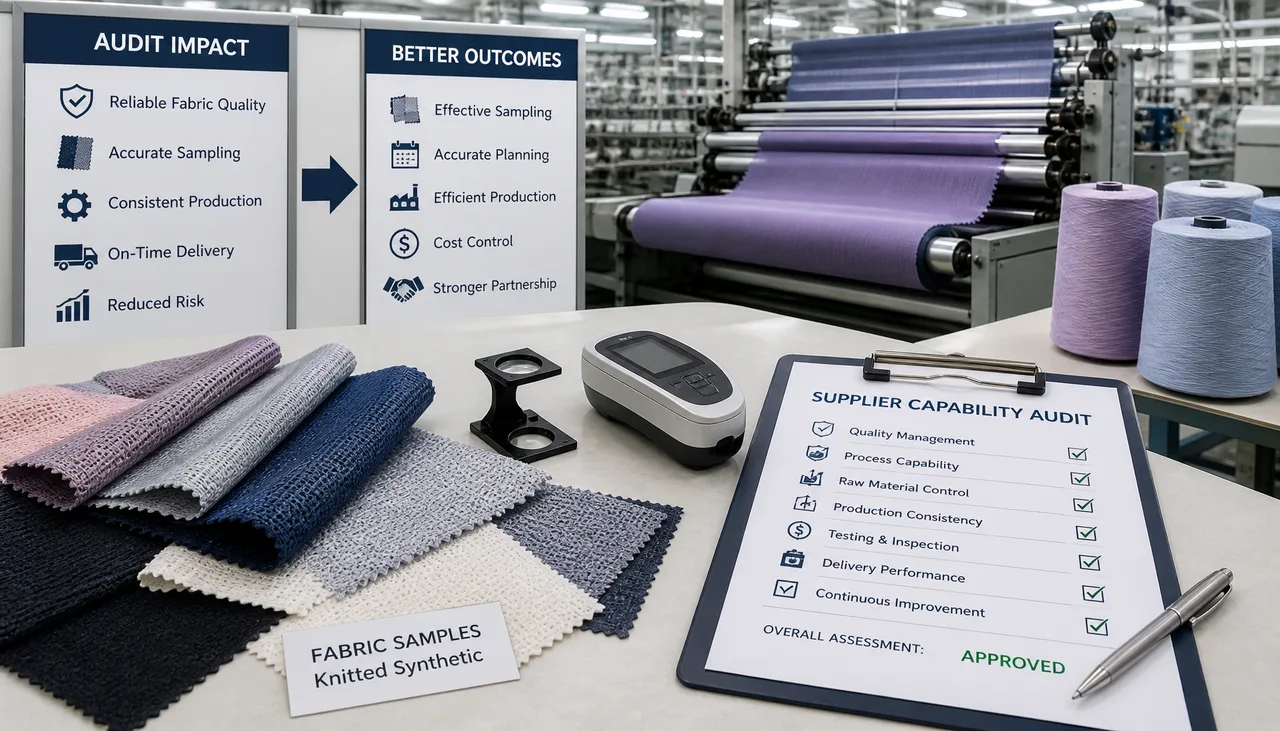
| Audit finding | Sampling implication | Bulk-planning implication |
|---|---|---|
| Existing construction with traceable production history | Confirm the current finish, color, test conditions, and retained reference | Use the verified route and monitor agreed lot controls |
| New yarn, knit, color, or finish | Add development trials and production-representative samples | Allow time for adjustment, retesting, and approval before booking garment cutting |
| Sample made on different equipment from bulk | Require a pilot or first-bulk lot from production equipment | Do not treat the laboratory sample as proof of bulk reproducibility |
| Critical process is subcontracted | Obtain a sample from the named processor and verify change control | Identify the processor, capacity, lead time, inspection point, and contingency |
| Weak roll or dye-lot traceability | Increase sample identification and inspection coverage | Hold shipment release until affected lots can be isolated |
| Limited test capability | Use an agreed external laboratory or buyer-nominated method | Add report lead time and define who authorizes shipment |
| Capacity depends on overtime or one machine | Verify production assumptions with a pilot schedule | Add realistic buffer or qualify an approved alternative route |
Confirm that the sample represents bulk production
A sample can pass while the bulk lot fails if it was knitted, dyed, or finished under a different process. The approved sample record should identify:
- fabric code, composition, construction, finished GSM, and usable width;
- yarn and material references available at approval;
- color, dyeing route, and finish;
- machine or process scale where it affects reproducibility;
- stretch, recovery, dimensional stability, colorfastness, and other required results;
- sample date, lot or trial reference, and approved physical swatch;
- permitted changes and the conditions that require buyer reapproval.
The buyer should ask which production variables changed between development, pilot, and bulk stages. Silence should not be treated as evidence that the process remained identical.
Use verified capacity to build the production schedule
Quoted capacity is not the same as available capacity. Review existing bookings, machine suitability, color-change time, testing, inspection, reprocessing allowance, maintenance, subcontractor queues, and shipment preparation.
Illustrative calculation — not ClothFactory capacity data: assume an order requires 12,000 kg within an eight-week production window. The audited route has 1,800 kg of available suitable capacity per week after confirmed bookings:
1,800 kg/week × 8 weeks = 14,400 kg
The nominal buffer is:
(14,400 − 12,000) ÷ 12,000 × 100 = 20%
That 20% does not prove the delivery is safe. Yarn availability, dye-lot sequencing, first-lot approval, testing, reprocessing, and subcontractor lead time may consume the buffer. The schedule should reserve time for these steps rather than allocating the complete window to nominal production output.
Link MOQ and batch size to color and process risk
The audit should verify actual minimum batch constraints for the selected construction, color, and finish. Do not apply a generic MOQ from another fabric or assume that sample quantity can be scaled directly to bulk.
Batch size affects more than purchasing volume. It can determine color-lot count, shade continuity, process settings, testing frequency, and replenishment options. Before deposit, confirm:
- MOQ and minimum dye or finish batch for the exact specification;
- whether quantities may be combined across colors or constructions;
- expected number of dye lots and roll sizes;
- policy for under- or over-delivery;
- replenishment feasibility and color-repeat procedure;
- commercial effect of pilot or first-lot production.
Set inspection coverage from demonstrated risk
A strong audit does not remove the need for bulk inspection. It helps decide where inspection should be concentrated.
Higher coverage may be appropriate when the order uses a new construction, new processor, high-risk pale or bright color, functional finish, narrow tolerance, or weak historical data. Stable repeat orders with demonstrated traceability may use a different risk-based plan, provided the purchase specification still defines release criteria.
The bulk control plan should identify:
- incoming-material and first-production checks;
- first dye-lot or first-finish approval;
- in-process GSM, width, shade, and construction controls;
- roll inspection and defect-grading requirements;
- performance tests by lot or risk condition;
- retained samples and report traceability;
- shipment-release authority and failed-lot disposition.
Audit communication and corrective-action capability
After-sales promises are less useful than a documented escalation route. Identify who receives a defect report, who can stop or release production, how affected rolls are contained, how root cause is recorded, and how corrective action is verified.
Review a completed nonconformance or corrective-action record with commercially sensitive details removed if necessary. The purpose is to see whether the supplier can isolate a problem by lot and process step, not merely promise replacement after shipment.
Avoid common supplier-audit mistakes
- Using one generic checklist for every fabric. Audit depth should follow the order's construction, finish, volume, and claim risk.
- Accepting stated capacity without current bookings. Installed output does not equal available suitable capacity.
- Ignoring subcontracted operations. Dyeing or finishing changes can affect the approved sample and delivery plan.
- Approving a laboratory sample as bulk evidence. Scale-up conditions may be different.
- Treating certification as process proof. A certificate does not show that the specific order route is controlled.
- Auditing production but not test and release authority. Good fabric can still be shipped without complete evidence when responsibilities are unclear.
- Applying an unrelated MOQ. Minimum quantities must be confirmed for the exact fabric, color, and process.
Procurement next step
Before sampling, send the supplier the intended application, specification, colors, finishes, test requirements, forecast volume, delivery window, and change-control expectations. Convert each material audit finding into a sample, schedule, inspection, or contingency action and attach the agreed controls to the purchase documents.
ClothFactory can use that order brief to coordinate fabric matching or development and provide the relevant process information available for the proposed route. Buyers should verify ownership, subcontracting, capacity, and quality controls for the actual order rather than infer them from a general company description.