
Please note: Choose team-jersey GSM from the required garment weight, coverage, climate, print process, and durability target; choose usable width from the actual graded marker. Do not approve either value in isolation. The purchasing specification should state finished GSM and usable width with tolerances, measurement conditions, and a rule for edge defects, because nominal width and quoted price per kilogram do not reveal the material cost per acceptable jersey.
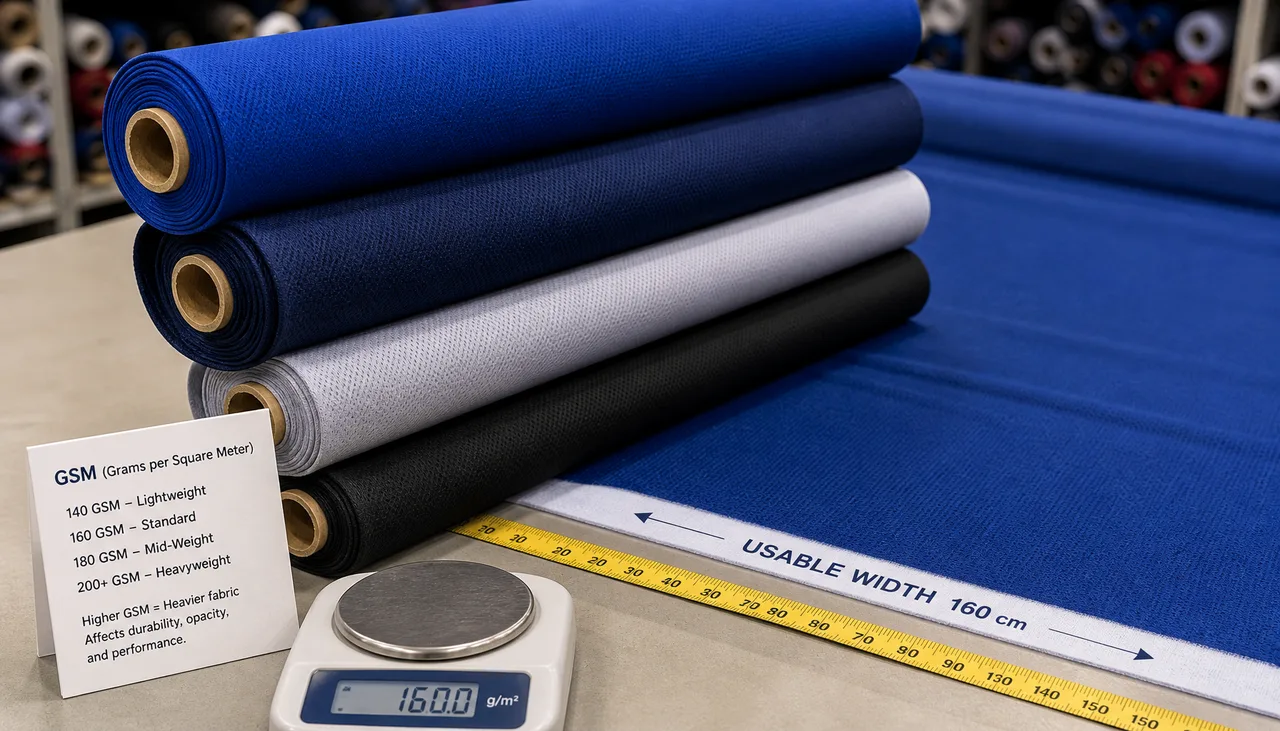
Start with the jersey system, not a generic GSM range
A training jersey used in hot weather, a match jersey carrying dense sublimation graphics, and a contact-sport top do not impose the same material demands. Lower GSM can reduce garment mass but may reduce coverage, snag resistance, sewing stability, or print appearance. Higher GSM may improve structure yet increase heat burden and drying time. Define the sport, fit, climate, contact level, decoration process, panel construction, and target garment mass before asking a supplier to recommend a polyester-spandex or nylon-spandex knit.
Translate GSM into estimated garment mass
Illustrative calculation: if the marker uses 0.78 m² of fabric per jersey and the selected fabric is 150 g/m², the theoretical fabric mass is 0.78 × 150 = 117 g before cutting loss, trims, thread, printing, and process allowances. At 180 g/m², the same area contributes 140.4 g, or 23.4 g more. This calculation does not identify the better fabric; it shows how a GSM decision changes the finished product and should be checked against a sewn sample.
Define usable width from the graded marker
Usable width is the defect-free cutting width after excluding edges that cannot be spread or cut reliably. Ask the marker team to test the complete size ratio, including names, numbers, stripe direction, print registration, and grain requirements. A wider roll provides no benefit if the extra edge is distorted or cannot accommodate another panel. Conversely, a small width difference can change whether two body panels nest side by side, causing a step change in consumption rather than a gradual one.
Compare cost on an equivalent basis
Illustrative calculation: fabric at 160 GSM with a 1.55 m usable width weighs 0.160 × 1.55 = 0.248 kg per linear metre. At USD 7.50/kg, the theoretical cost is USD 1.86 per usable metre. This remains incomplete until marker consumption and cutting loss are known. If a narrower quality requires more length per jersey, its lower kilogram price may still produce a higher fabric cost per garment.
| Input | Why it changes the decision | How to verify |
|---|---|---|
| Finished GSM | Affects garment mass, coverage and handling | Conditioned measurement across representative positions |
| Usable width | Controls panel nesting and marker efficiency | Measure defect-free width under agreed tension |
| Print or decoration | May change opacity, hand and dimensional behavior | Approve decorated garment, not blank fabric alone |
| Size ratio | Changes marker utilization | Run the production size mix through the marker |
| Dimensional stability | Changes post-process panel dimensions | Test after the agreed wash or heat exposure |
Write tolerances and measurement conditions
Specify whether GSM is measured on conditioned finished fabric and how many positions are checked. Define usable width as a minimum acceptable cutting width, not merely total laid-flat width, and state whether edge curl, pin marks, shading, holes, or distortion reduce it. The purchase order should also cover width variation within and between rolls, because an average can pass while individual sections are too narrow for the approved marker. Agree on the action for nonconforming rolls before shipment.
Validate with production-relevant samples
Request enough identified yardage to print or decorate, relax, spread, cut, sew, wash, and fit the full jersey size range. Measure GSM and usable width before and after relevant processing, then compare actual marker consumption with the estimate. Approval should link the physical fabric standard to numerical tolerances and the finished garment result. A hand swatch can screen color and touch, but it cannot establish cutting yield, printing response, or size stability.
RFQ fields for a comparable quotation
Send suppliers the sport and climate, garment fit, composition preference, knit structure, target finished GSM and tolerance, minimum usable width, size ratio, decoration route, dimensional-stability requirement, color plan, test methods, forecast volume, and acceptance procedure. ClothFactory can use these inputs to match or develop candidate knitted stretch fabrics. The buyer should award the order only after measured width, marker yield, decorated appearance, and garment performance meet the same written approval basis.