
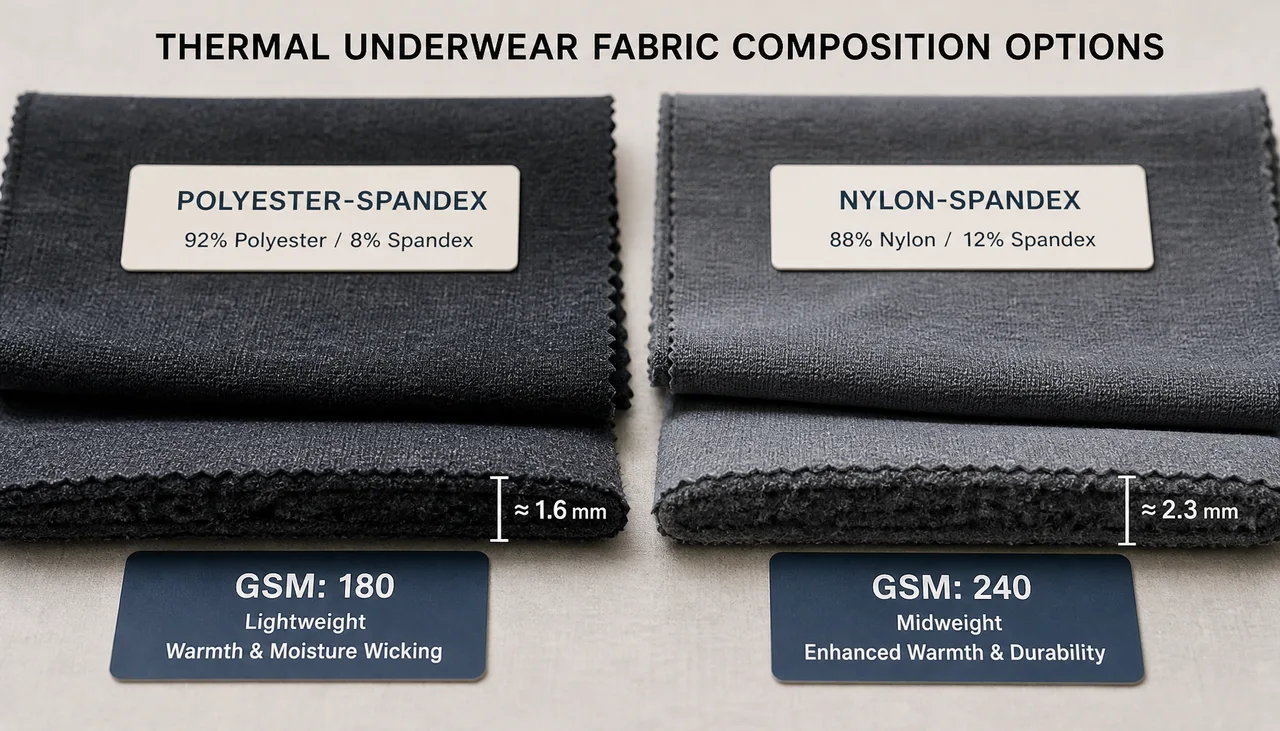
For thermal underwear, compare nylon-spandex and polyester-spandex against next-to-skin comfort, moisture conditions, insulation targets, stretch recovery, and the planned care cycle. Fiber composition alone cannot predict warmth or fit; GSM, knit construction, finishing, and test conditions should be approved together before bulk sourcing.
Start with the garment brief
A close-fitting base layer worn under another garment has different requirements from a standalone winter top. Before requesting samples, record the intended climate, layering position, body zones that need coverage, target fit, color range, and wash instructions. These inputs determine whether the priority is a light hand and low bulk, a more stable surface, moisture transfer, or additional insulation.
For example, a brand developing a thin base layer for indoor-to-outdoor commuting may prefer a lower-bulk construction that fits under a sweater. A heavier winter layer may accept more fabric mass if the added coverage and air volume justify it. This is a product brief decision, not a conclusion that one fiber family is universally warmer.
Compare composition without treating it as a performance guarantee
Nylon-spandex and polyester-spandex are both viable starting points for stretch thermal underwear. Use composition to narrow the candidate list, then compare the finished fabric under the same test conditions.
| Procurement question | What the fiber choice may indicate | What still requires confirmation |
|---|---|---|
| Next-to-skin hand | Nylon-spandex is often considered when a smooth, soft hand is important. Polyester-spandex can also be engineered for a soft hand through yarn selection and finishing. | Hand feel after dyeing, finishing, and the specified wash cycle. |
| Moisture handling | Polyester is often considered for quick-dry constructions, but wicking depends on yarn, knit geometry, finishing, and garment design. | Wicking and drying results on the finished fabric, with the method and conditioning stated. |
| Warmth and coverage | Either fiber family can be used in lightweight or more substantial constructions. | Finished GSM, thickness, cover, knit structure, and any brushing or other thermal finish. |
| Stretch and recovery | Spandex content can support stretch, but the percentage does not define the final fit response. | Stretch and recovery in both directions, extension level, hold time, recovery time, and results after washing. |
| Surface durability | Fiber selection is only one part of abrasion and pilling performance. | Pilling, abrasion, snagging, and dimensional stability for the actual construction and finish. |
This comparison prevents a common sourcing error: approving a composition name while leaving the construction and acceptance conditions undefined.
Use GSM to estimate garment mass, not to claim warmth
GSM is useful for costing, marker planning, and garment-weight estimates. It is not a standalone thermal rating. Yarn size, loop geometry, thickness, air volume, surface treatment, and garment coverage can change the warmth and moisture behavior of fabrics with similar GSM.
Illustrative calculation — not a ClothFactory test result: if the finished fabric area in a garment is assumed to be 1.2 m², a 180 gsm fabric contributes approximately:
1.2 m² × 180 g/m² = 216 g
A 240 gsm option would contribute approximately 288 g under the same area assumption, a difference of 72 g before seams, trims, cutting waste, and any panels in other materials. Use the calculation to compare garment mass and consumption; verify warmth through the finished construction and garment sample.
Specify knit structure and finishing separately
The same fiber blend can produce very different thermal underwear depending on how it is knitted and finished. Ask the supplier to identify the construction, finished width, GSM, thickness if relevant, and any surface treatment. If a brushed or other thermal finish is proposed, confirm whether it is part of the standard specification or an optional development step.
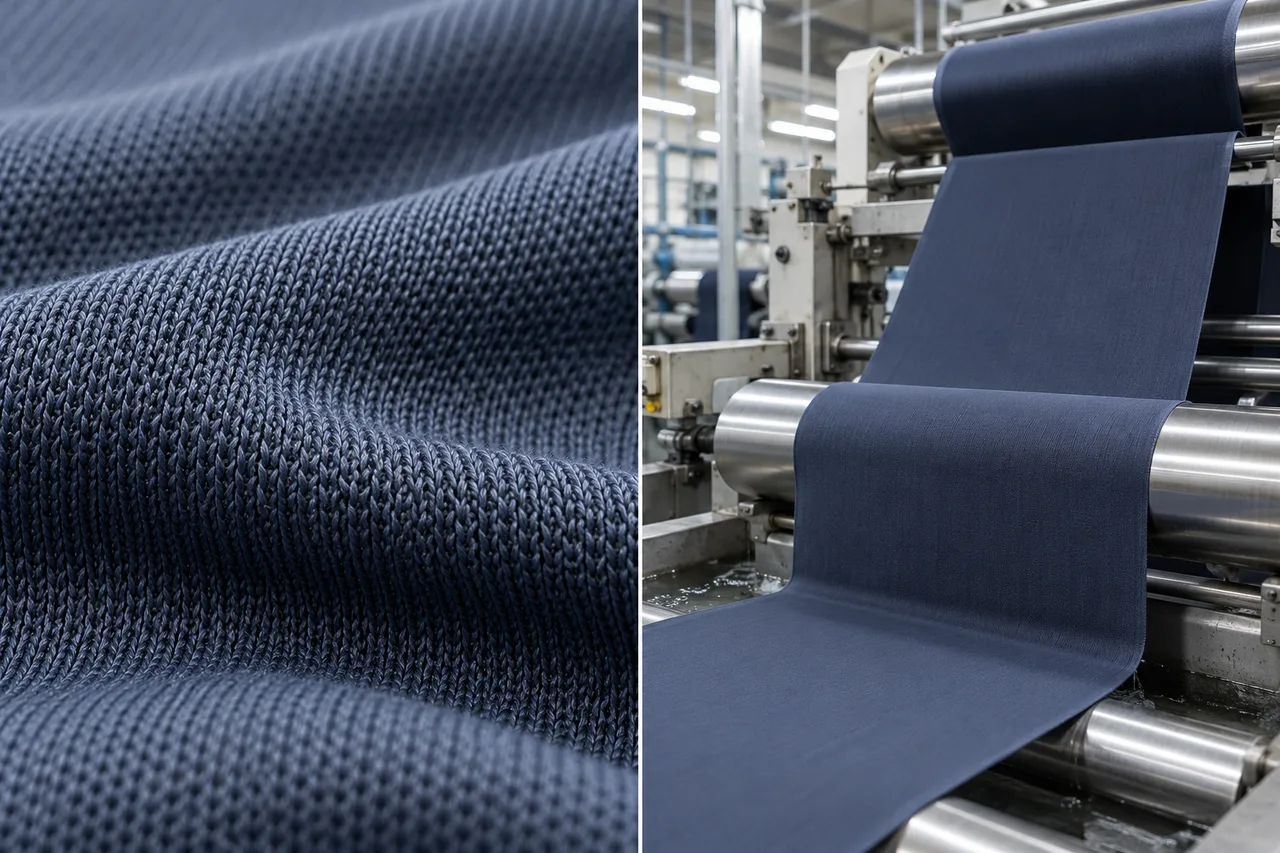
Finishing may change hand feel, moisture behavior, pilling, color appearance, and dimensional stability. A fabric that feels suitable before washing may not provide the same surface or recovery after the agreed care cycle. Approval should therefore use finished, laundered samples where the end product will be sold with a care label.
Build a comparable sample request
Send the same brief to each candidate supplier. At minimum, request:
- target composition and any permitted tolerance;
- finished GSM range, usable width, and knit construction;
- stretch and recovery requirements by direction, including extension, hold time, and recovery time;
- dimensional stability and spirality after the specified wash procedure;
- pilling, abrasion, colorfastness, and snagging requirements relevant to the end use;
- hand-feel reference, target shade, and whether the finish is required or optional;
- sample identification that links each swatch to its specification sheet.
Do not compare one supplier’s finished GSM with another supplier’s greige GSM, or compare recovery values produced with different extension levels and recovery times. The numbers may look comparable while describing different tests.
Avoid these approval mistakes
- Selecting by blend name alone. A nylon-spandex label does not specify knit density, finish, GSM, or recovery.
- Using GSM as a warmth guarantee. Higher mass may increase coverage or weight without delivering the expected insulation.
- Approving one color for every color. Dye depth and finishing can affect hand, stretch response, and colorfastness; confirm the production shade range separately.
- Treating a fabric test as a garment result. Fit, seam placement, paneling, and laundering can change the wear outcome.
- Leaving the care cycle open. Test conditions should reflect the intended label and the buyer’s quality threshold.
Procurement next step
Prepare a one-page brief with the end use, layering position, target composition, GSM and width, fit intent, shade, finish, care cycle, and required tests. Ask for identified samples and a specification sheet, then approve the fabric only after the construction and test conditions match the product brief. ClothFactory can use that information to compare an existing nylon-spandex or polyester-spandex base fabric with a development option, while keeping any unconfirmed performance requirement open for sampling and verification.