
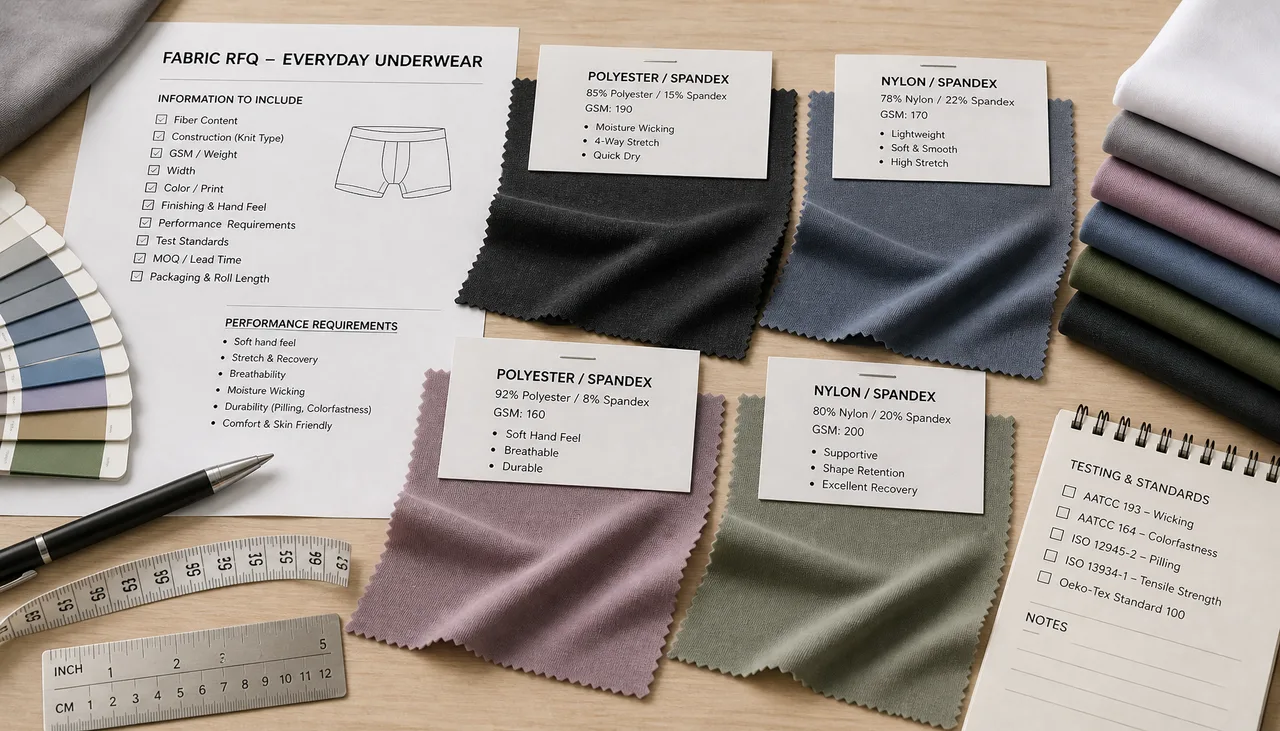
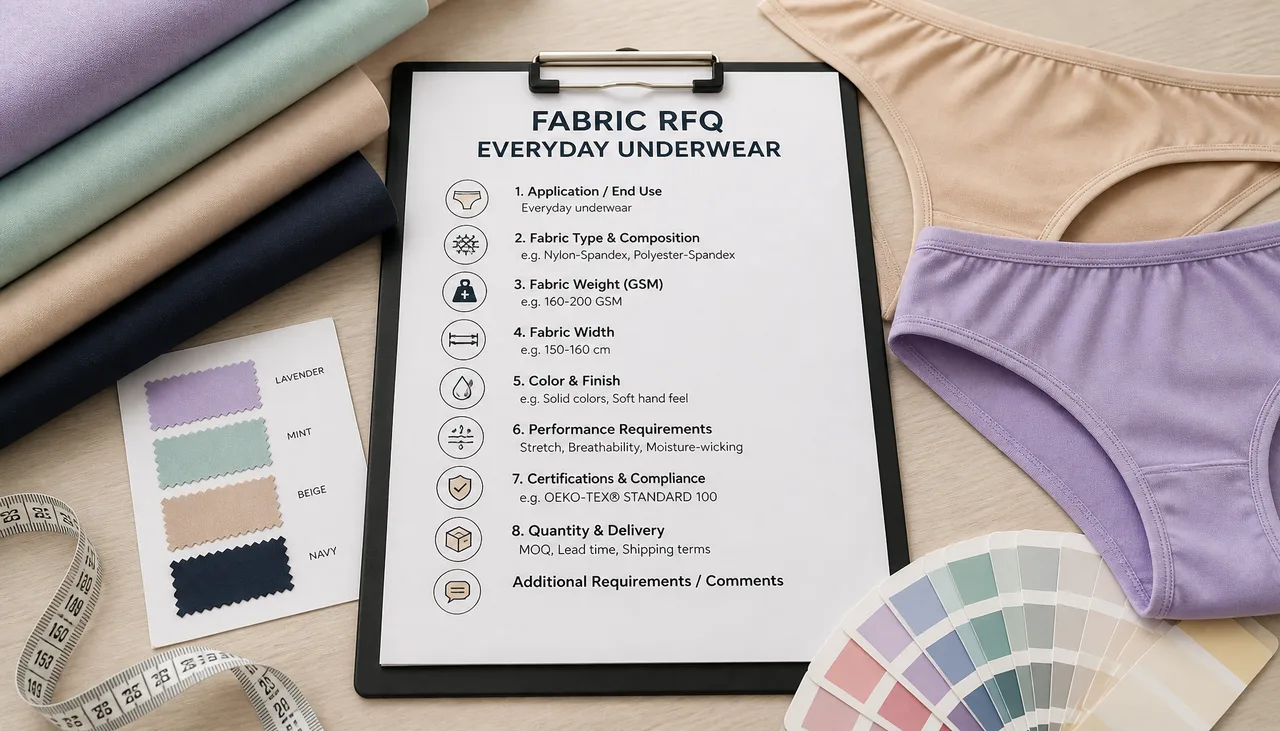
An everyday-underwear fabric RFQ should define the wearer, garment construction, skin-contact face, composition and knit preferences, finished GSM, usable width, stretch and recovery, opacity, color, finish, care conditions, test requirements, quantities, and approval process. It should distinguish mandatory limits from development preferences. Suppliers cannot prepare comparable quotations when the request contains only a fiber blend, a photo, or terms such as “soft,” “breathable,” and “high quality.”
Describe the garment and wearer first
State whether the program covers briefs, boxer briefs, seamless-style cut-and-sew underwear, waistbands, gussets, or lining, because each panel may require a different material. Include wearer segment, intended fit, size range, climate, contact duration, seam type, lining, elastic integration, and target retail position. A close-fitting daily garment prioritizes low irritation and recovery after repeated wear, but the required support, coverage, and thermal comfort differ between silhouettes and markets.
Specify construction and measurable dimensions
- Preferred fiber composition and acceptable alternatives, without assuming composition guarantees performance.
- Knit structure, face and reverse, finished GSM, minimum usable width and tolerances.
- Required stretch direction, extension, recovery or growth, and test conditions.
- Color, opacity at relevant extension, surface appearance, hand standard and edge behavior.
- Dimensional stability under the intended wash and drying procedure.
Nylon-spandex and polyester-spandex may both be suitable starting points, but yarn type, knit geometry, finishing, and garment design determine the final experience. If the buyer accepts either family, ask suppliers to explain the commercial and technical trade-off rather than naming a preferred fiber without a reason. Where softness is critical, submit an identified reference swatch and describe which face touches the skin; subjective language alone cannot be priced or inspected consistently.
State functional claims as validation tasks
If the product brief requests moisture management, cooling sensation, odor control, or another function, identify whether it is mandatory, the intended mechanism if known, the test method, acceptance criterion, care cycles, and claim market. Do not assume every candidate fabric has these properties or that an optional finish remains effective after laundering. The supplier should quote the base construction and any requested functional route clearly enough for the buyer to compare cost, durability, hand change, and testing responsibility.
Include garment and color risks
Underwear can expose risks that a flat swatch hides: seam grin, edge curl, elastic recovery mismatch, show-through, crocking, staining, and dimensional change after repeated care. Pale and dark colors may not behave identically, and passing one shade does not approve the range. Ask for development and bulk color procedures, controlled light-source assessment, shade continuity rules, and appropriate colorfastness requirements. Validate representative light and dark garments in the intended wash system.
Give suppliers a usable quantity forecast
Provide expected kilograms or metres by color, launch quantity, repeat-order forecast, target delivery window, and destination. Ask each supplier to state minimum dye-lot or order conditions, sample charges, lead-time assumptions, over- or under-delivery tolerance, and whether quotation is by kilogram, metre, or yard. Do not insert an unverified “standard MOQ” into the RFQ. Order conditions depend on construction, yarn availability, dyeing route, color, and supplier capacity and must be confirmed for the proposed quality.
Compare cost per approved garment
Illustrative calculation: at 170 GSM and 1.50 m usable width, one linear metre weighs 0.170 × 1.50 = 0.255 kg. If the quotation is USD 8.00/kg, theoretical fabric cost is USD 2.04 per usable metre before cutting loss. Actual underwear cost requires the production marker, relaxation, defects, shade segregation, and process loss. Request finished GSM and minimum usable width so quotations can be converted to the same commercial basis.
| Document or sample | Purpose |
|---|---|
| Technical data | Confirms proposed construction, dimensions and stated test conditions |
| Identified swatch | Supports face, hand, shade and appearance review |
| Sample yardage | Enables sewing, fit, opacity, wash and marker trials |
| Test report | Provides evidence tied to the exact quality and sample state |
| Commercial quotation | States unit basis, quantities, lead-time assumptions and exclusions |
End the RFQ with a clear development gate: initial proposal, identified sample, laboratory and garment trial, color approval, production-relevant confirmation, and bulk release. State who owns testing and what requires reapproval after a change. ClothFactory can assess the brief against knitted synthetic stretch options, while the buyer retains the final performance limits. A structured RFQ reduces repeated sampling and makes technical suitability and total material cost visible before commitment.