
Please keep in mind: Usable width is a cutting specification, not simply the total distance from one fabric edge to the other. Buyers should define the minimum defect-free width, measurement tension, relaxation and conditioning state, excluded edge conditions, within-roll sampling, and action for narrow sections. The largest commercial risk is approving an average or nominal width that cannot accommodate the production marker, causing higher consumption, panel rotation, extra seams, or cutting stoppages.
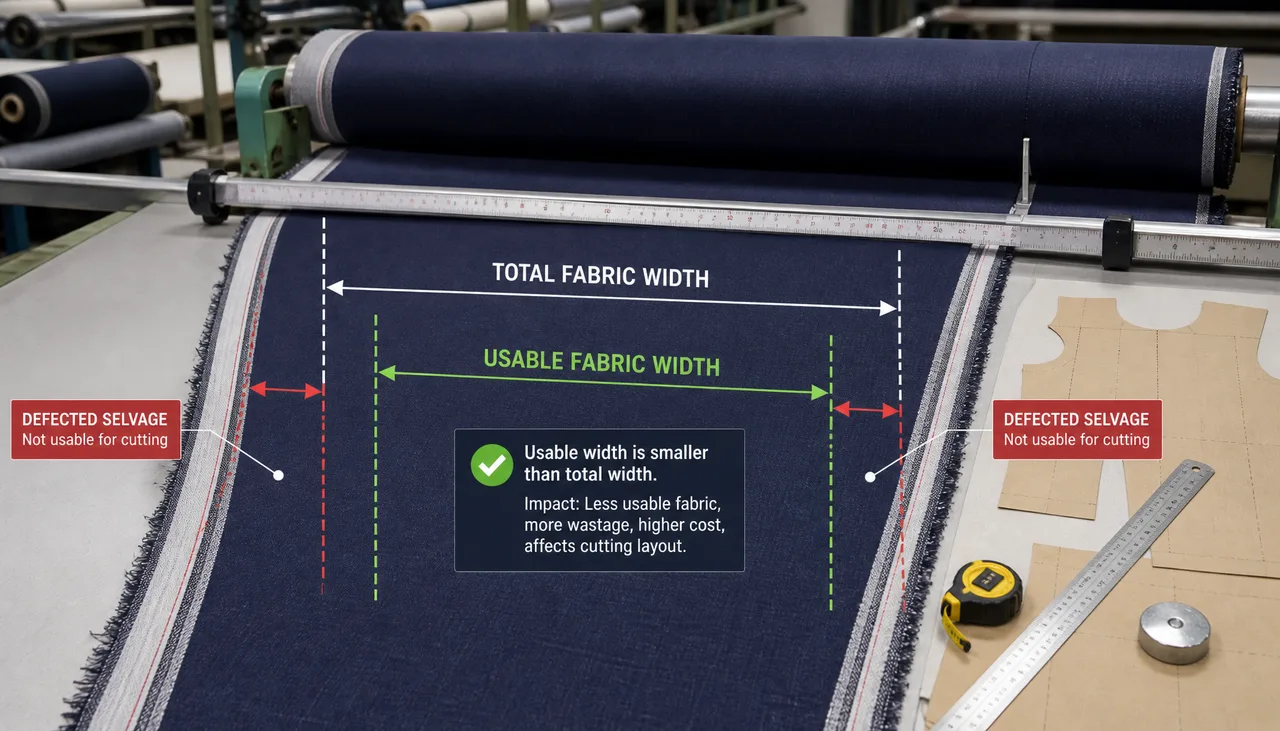
Define usable width in the purchase specification
State whether width is measured open, tubular, or laid flat; whether the value is total or usable; and how edge curl, pin marks, holes, glue, discoloration, distortion, or unstable selvedges are excluded. Knitted fabric should be measured under controlled, minimal tension after the agreed relaxation or conditioning period. If the supplier and garment factory use different tension or exclusion rules, both can report a correct number while referring to different cutting areas.
Test the width against the actual marker
A width tolerance matters only in relation to panel geometry. Run the complete graded size ratio, grain direction, nap or print direction, matching constraints, and permitted panel rotation through the marker. A reduction of one centimetre may have little effect on one style but can prevent two panels from nesting side by side in another. Approve the minimum usable width required by the production marker and retain a contingency for normal spreading and cutting control.
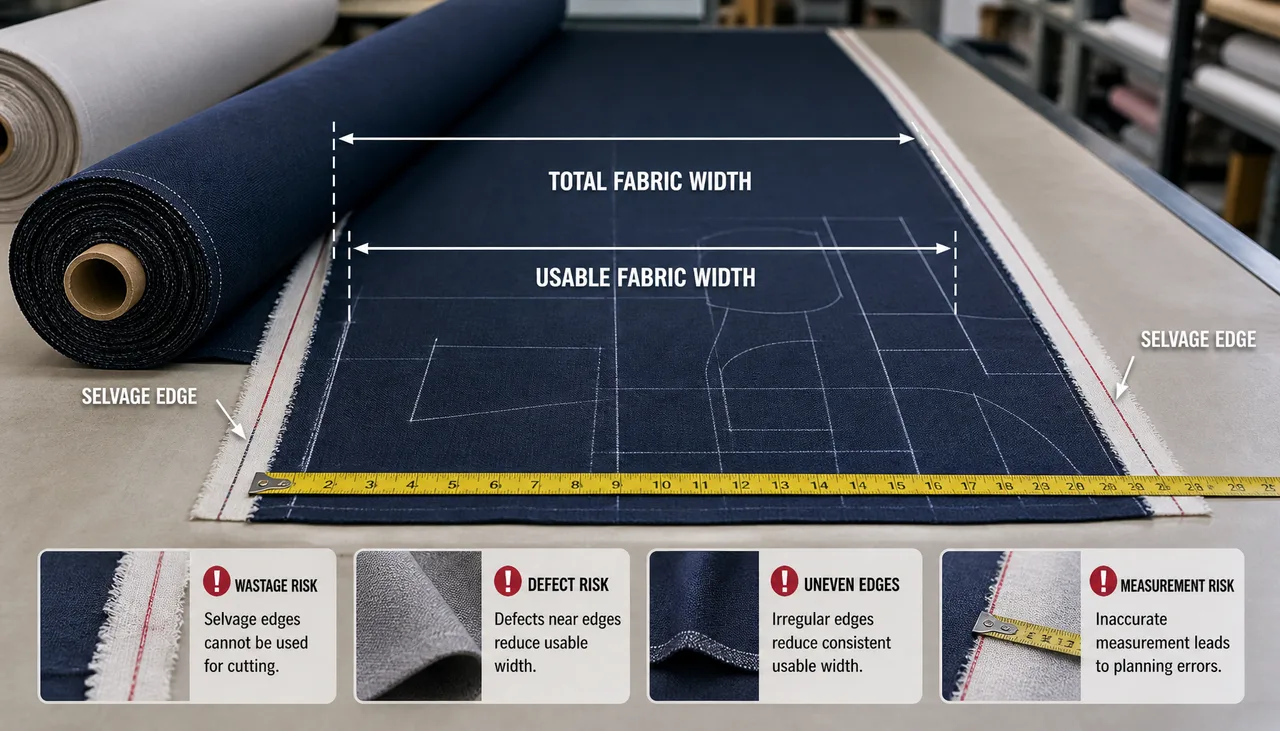
Do not rely on the lot average
Hypothetical example: five measured sections are 152, 152, 151, 148, and 152 cm usable width. The average is 151 cm, but a marker requiring 150 cm fails at the 148 cm section. Specify a minimum section or roll value where that reflects production risk, not only an average. Record measurements by roll and position so narrow areas can be segregated, re-planned, or rejected before they interrupt spreading.
Account for relaxation and dimensional change
Width can change after finishing, packing tension, warehouse relaxation, steaming, washing, printing, or heat treatment. Define the state in which incoming width is accepted and the state needed for marker planning. If the garment process exposes fabric to heat or moisture before cutting, reproduce that exposure during development. A relaxed wider fabric may shorten in length, while a tensioned roll can appear wider than it behaves on the cutting table; both effects influence consumption.
Connect width, GSM, and quotation units
Illustrative calculation: fabric at 200 GSM and 1.50 m usable width weighs 0.200 × 1.50 = 0.300 kg per linear metre. At 1.45 m usable width, the same GSM gives 0.290 kg per metre, but more linear metres may be required if marker efficiency falls. A kilogram quotation cannot be compared fairly until finished GSM, minimum usable width, marker consumption, and expected cutting loss are converted into cost per acceptable garment.
| Risk | Required control |
|---|---|
| Edge curl or damage | Define excluded edge and measure only stable cutting width |
| Within-roll variation | Measure at agreed intervals and retain position records |
| Lot variation | Sample rolls across dyeing and finishing batches |
| Marker mismatch | Validate the production size ratio at minimum width |
| Process shrinkage | Measure before and after relevant relaxation, heat or wash exposure |
Set a response for nonconforming rolls
The purchase order should define whether narrow material is rejected, segregated, downgraded, re-planned, or compensated through additional length. State who measures width, which equipment and interval are used, how disputes are confirmed, and whether the supplier must identify affected roll sections. Without a pre-agreed action, the garment factory may consume extra fabric to protect delivery while purchasing discovers the cost only after cutting.
Approval checklist
Send ClothFactory or any shortlisted supplier the open or tubular format, minimum usable width, width tolerance, finished GSM, fabric face, measurement condition, excluded-edge rule, marker requirement, processing route, and bulk inspection plan. Request representative sample yardage rather than relying on a small swatch. Approve the construction only after relaxed width, production marker efficiency, relevant dimensional change, and roll-level control can support the planned garment quantity and cost.