
Helpful tips: Compare hiking-shirt fabric suppliers on verified performance under one specification, not on fiber content, feature lists, or price per kilogram. The brief should define climate, trip intensity, pack contact, garment fit, care conditions, finished GSM, usable width, stretch, drying or moisture requirements, durability, and optional finishes. Evaluate candidate fabrics in the intended garment, then audit how each supplier reproduces the approved construction across colors, lots, and repeat orders.
Define the hiking scenario
A lightweight shirt for humid day hikes, a close-fitting stretch top under a backpack, and a cool-weather trekking layer require different trade-offs. State expected temperature and humidity if the brand has a defined use range, exertion level, duration, pack weight and contact zones, layering, fit, sun exposure, and wash access. These inputs determine whether the project prioritizes airflow, drying, warmth, surface durability, low wet cling, stretch recovery, coverage, or garment mass.
Compare constructions, not generic fiber claims
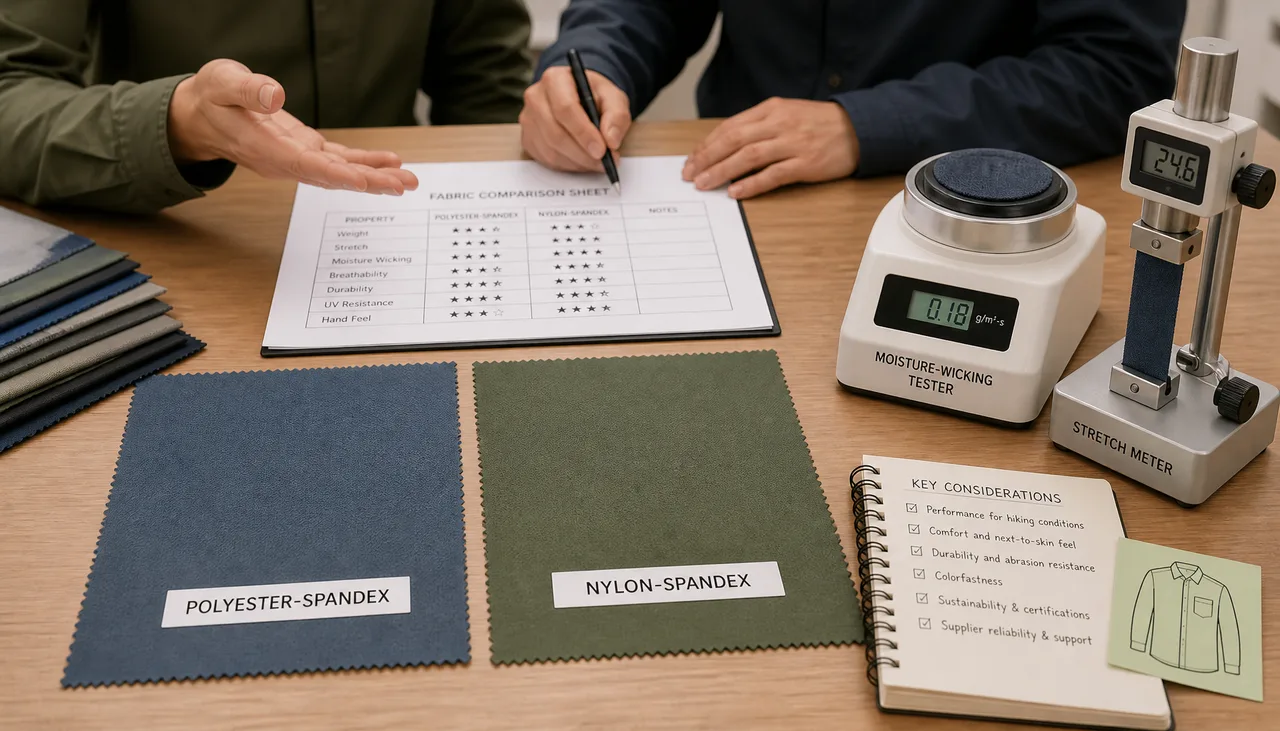
Polyester-spandex and nylon-spandex can both support hiking apparel, but fiber names do not establish air permeability, drying time, abrasion resistance, snagging, hand, or recovery. Yarn form, filament size, knit structure, stitch density, dye route, and finishing matter. Require each supplier to disclose the finished composition, construction, GSM, usable width, stretch directions, surface treatment, and which performance claims depend on an optional finish. Compare only candidates developed for the same shirt and test matrix.
Build a risk-based verification matrix
| Use risk | Evidence to request | Garment check |
|---|---|---|
| Sweat and drying | Agreed moisture or drying method with full conditions | Wet cling and comfort during representative wear |
| Backpack contact | Relevant abrasion, pilling or snag evaluation | Shoulder and back-panel trial |
| Movement | Directional stretch and recovery results | Reach, arm lift, hem movement and fit retention |
| Repeated care | Dimensional stability, appearance and colorfastness | Measurement and appearance after agreed cycles |
| Optional claim | Method, acceptance limit and durability condition | Claim wording limited to verified evidence |
Issue the same methods, specimen states, units, and acceptance criteria to every supplier. A report produced on another color or construction is background information, not approval evidence for the submitted fabric. When the brand lacks a limit, test several candidates under identical conditions, use a validated reference garment where available, and set the purchasing threshold from the chosen performance level. Avoid selecting the highest isolated value when overall comfort and durability require balance.
Compare total material cost
Illustrative calculation: a fabric at 145 GSM and 1.55 m usable width weighs 0.145 × 1.55 = 0.22475 kg per linear metre. At USD 8.20/kg, theoretical cost is approximately USD 1.84 per usable metre before cutting loss. A second fabric with a lower kilogram price may cost more per shirt if it is heavier, narrower, or less efficient in the graded marker. Replace these figures with actual quotations and marker consumption.
Verify optional finishes and their trade-offs
Odor-control, cooling, water-repellent, or UV-related claims should never be inferred from the base fiber. Ask whether the effect comes from construction, fiber, dyeing, or a finish; which test supports it; and how laundering changes the result. Evaluate any change in hand, shade, air permeability, wicking, print compatibility, cost, and lead time. Approving an untreated sample while ordering a treated bulk version creates a new material state and should trigger relevant revalidation.
Audit sample-to-bulk control
Ask each supplier how sample identity links to yarn, greige batch, dye lot, finishing route, test report, and finished rolls. Review controls for GSM, width, shade, bow or skew, defects, and relevant performance properties. Confirm change-notification rules for yarn source, settings, chemicals, plant, or subcontractor. Repeat-order capability should be judged from documented records and retained standards, not from a promise that the same fabric code will always behave identically.
Run a production-relevant trial
Request identified yardage sufficient for laboratory tests, decoration, spreading, sewing, fitting, backpack-contact evaluation, and the agreed care cycles. Test representative light and dark colors when color chemistry may affect results. Record every deviation before approval. Send ClothFactory or another supplier one RFQ containing the garment scenario, construction and dimension targets, performance matrix, forecast quantity, color plan, timeline, and bulk acceptance procedure so price and capability are evaluated on the same basis.