
Before paying a fabric deposit, buyers should verify a traceable finished-fabric sample and place the nominal GSM, tolerance, test method, conditioning, sampling plan, and rejection action in the purchase specification. A pre-production sample can confirm the agreed measurement basis, but it cannot guarantee bulk consistency unless the order also defines how rolls and lots will be inspected.
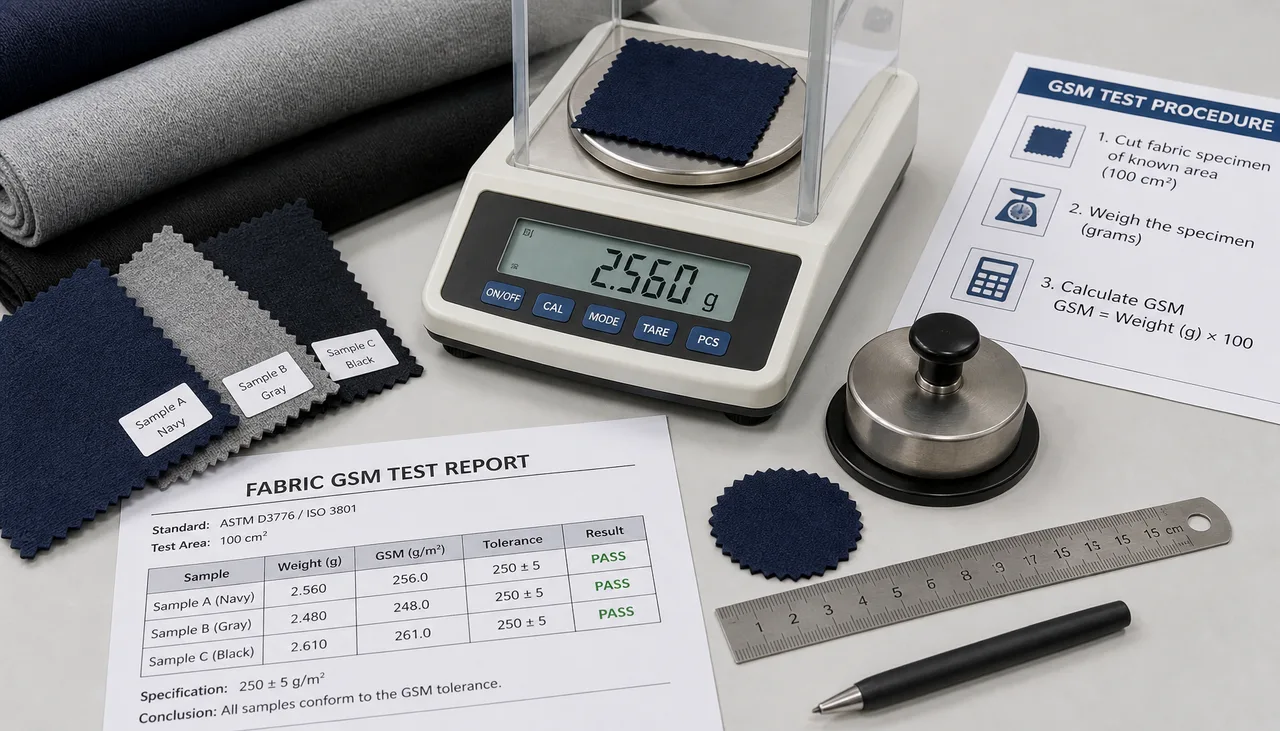
Agree on what “GSM tolerance” means
A quotation that states only “220 gsm” is incomplete. Before the deposit, the buyer and supplier should agree on:
- nominal GSM of the finished fabric;
- tolerance expressed as a percentage or an absolute range;
- whether the limit applies to every specimen, each roll average, or the production-lot average;
- test method, cutter area, balance precision, conditioning, and relaxation time;
- whether the sample is greige, dyed, heat-set, brushed, or otherwise finished;
- sampling positions across the usable width and along each selected roll;
- number or percentage of rolls to inspect;
- action for an out-of-tolerance roll or lot.
These details matter because a lot average can pass while individual rolls or edge-to-center positions fall outside the intended range.
Verify a traceable finished-fabric sample
Request a sample identified by fabric code, composition, knit construction, color, finish, usable width, and production or development reference. The GSM measurement should be taken after the sample has been relaxed and conditioned under the agreed procedure.
Do not rely on one cut specimen. Take multiple specimens from distributed positions, avoiding selvedges, creases, visible defects, and overlapping locations. Record each weight, the calculated GSM, minimum, maximum, and average. The supplier and buyer should retain matched reference samples where practical.
Check the GSM calculation
GSM is the specimen mass divided by its area in square meters:
GSM = specimen mass (g) ÷ specimen area (m²)
Illustrative calculation — not a ClothFactory test result: a 100 cm² specimen has an area of 0.01 m². If it weighs 2.20 g:
2.20 g ÷ 0.01 m² = 220 g/m²
With a 100 cm² cutter, multiplying the specimen weight in grams by 100 gives the GSM. A calibrated cutter and suitable balance are still required; inaccurate area or rounding can distort the result.
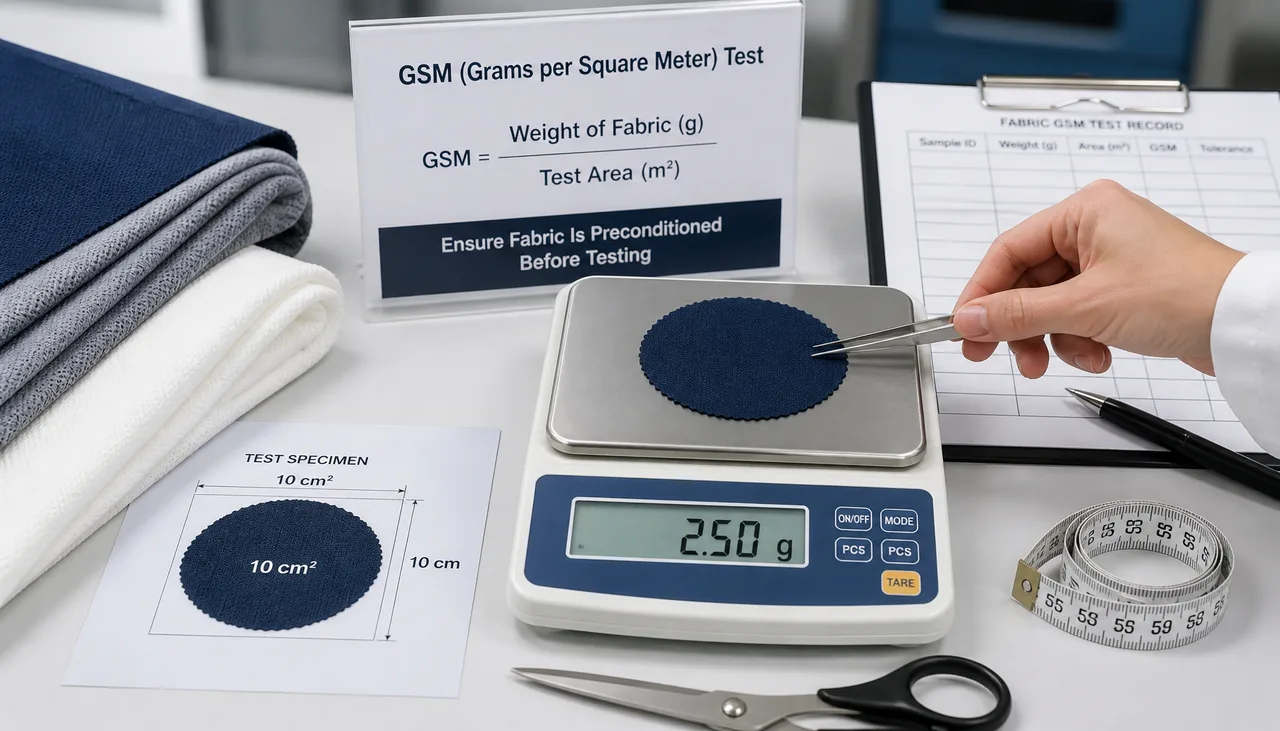
Interpret the tolerance before accepting the result
Illustrative specification — not a ClothFactory production tolerance: a nominal 220 gsm fabric with an agreed tolerance of ±5% has an acceptable numerical range of:
220 × 0.95 = 209 gsm
220 × 1.05 = 231 gsm
The calculation does not show whether every specimen must fall between 209 and 231 gsm or whether only a roll or lot average must fall within that range. The purchase specification must state the acceptance unit.
For example, five readings of 210, 214, 220, 226, and 234 gsm average 220.8 gsm. The average is close to nominal, but the 234 gsm specimen exceeds the illustrative upper limit. Whether the material passes depends on the agreed rule, not the average alone.
Confirm that the sample represents the quoted product
GSM can change during dyeing, heat setting, relaxation, brushing, coating, and other finishing operations. A greige or unfinished sample should not be used to approve a finished-fabric tolerance unless the conversion basis is documented and later verified.
Confirm that the quoted price, width, composition, finish, and GSM refer to the same construction. A lower finished width or higher GSM can change fabric yield and garment cost even when the price per kilogram appears unchanged.
Estimate the commercial effect of GSM variation
GSM affects the weight of a known fabric area. It does not by itself establish durability, opacity, hand feel, or performance.
Illustrative calculation — not order data: assume 600 linear meters of fabric with a usable width of 1.5 meters. The total area is:
600 m × 1.5 m = 900 m²
At 220 gsm, the theoretical fabric mass is 198 kg. At the illustrative limits of 209 and 231 gsm, it ranges from 188.1 to 207.9 kg. This simplified calculation excludes unusable edges, roll length variation, moisture differences, and cutting loss, but it shows why GSM and usable width should be reviewed together when comparing yield and cost.
Convert the agreement into deposit documents
Before payment, place the following in the purchase order, specification sheet, or signed quality annex:
- fabric code, composition, knit construction, color, and finish;
- nominal finished GSM and tolerance;
- usable width and its tolerance;
- approved reference sample and report identity;
- test method, conditioning, and specimen plan;
- roll- and lot-level acceptance rules;
- pre-shipment inspection requirement, if applicable;
- agreed action for failed rolls, shortages, replacement, or reprocessing.
The document should use measurable requirements rather than phrases such as “approximately 220 gsm” or “normal industry tolerance.” Commercial remedies and payment terms should be reviewed by the buyer's responsible purchasing or legal team.
Recheck GSM during bulk production
Deposit-stage verification establishes the specification; bulk inspection establishes conformance. Request production-lot results and verify selected rolls before shipment or cutting. Sampling should cover different rolls and distributed positions rather than only the first roll or one convenient location.
If buyer and supplier results differ, compare conditioning, relaxation, cutter area, balance calibration, specimen location, and rounding before deciding that the lot has failed. Retest matched specimens under one agreed procedure when necessary.
Avoid common GSM-approval mistakes
- Testing one specimen. A single cut cannot show widthwise or roll-to-roll variation.
- Approving greige GSM for a finished order. Dyeing and finishing can change the result.
- Leaving the acceptance unit undefined. Specimen, roll, and lot averages answer different questions.
- Ignoring usable width. GSM alone does not determine linear-meter yield or garment consumption.
- Accepting a verbal tolerance. The range and failure action should appear in the order documents.
- Treating the sample as a bulk guarantee. Production rolls still require traceable inspection.
- Assuming GSM proves performance. Stretch recovery, dimensional stability, opacity, pilling, and colorfastness need separate requirements.
Procurement next step
Send the supplier the intended application, nominal finished GSM, tolerance, usable width, finish, color, sample plan, and required test condition. Request an identified finished sample and full readings before deposit, then place the same requirements in the purchase documents and bulk inspection plan. ClothFactory can prepare or match a nylon-spandex or polyester-spandex sample against that brief, while final acceptance remains tied to the agreed measurements and production-lot results.