
Before paying a fabric deposit, buyers should obtain a written approval matrix that defines the sample type, reference standard, acceptance criteria, revision responsibility, approval authority, and the exact event that authorizes bulk production. For printed fabric, that sample may be a strike-off; for a solid dyed nylon-spandex or polyester-spandex fabric, the relevant color approval is usually a lab dip rather than a strike-off.
Confirm what the supplier means by “strike-off”
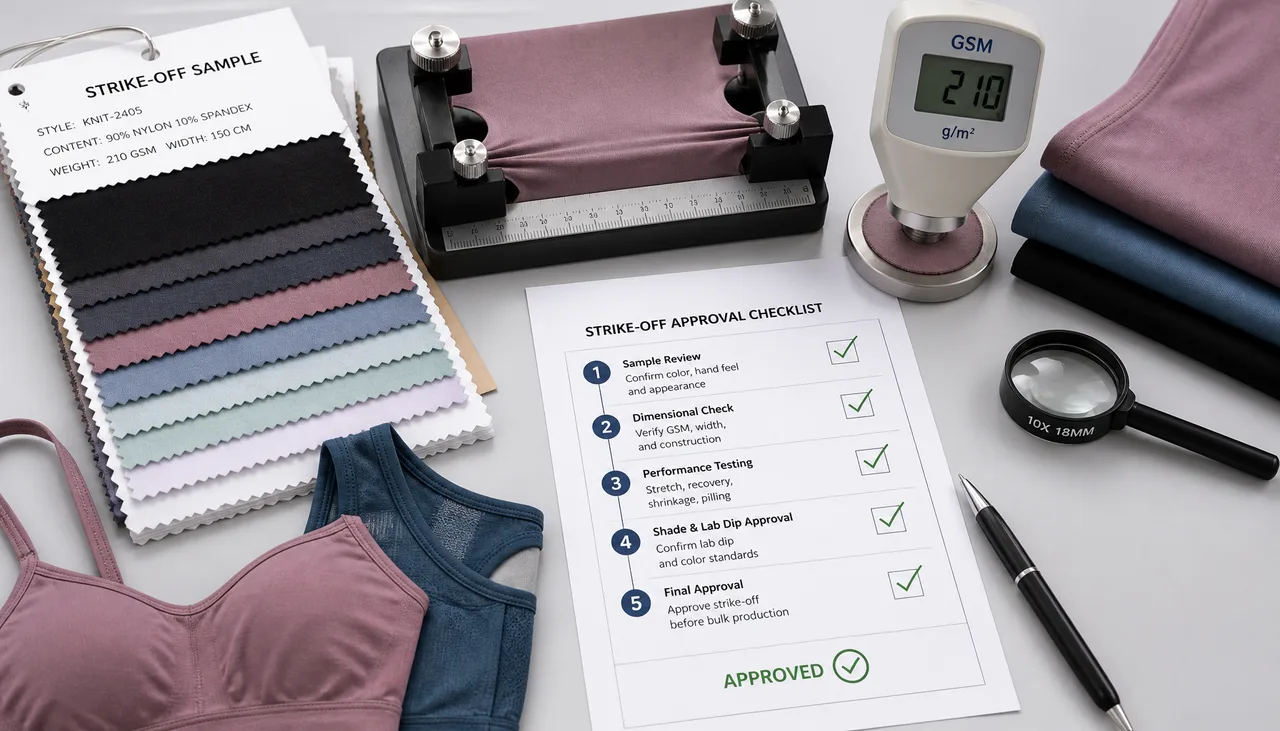
Terminology must be resolved before discussing payment. A strike-off normally shows how a print artwork, color combination, scale, and placement reproduce on a specified fabric. It is not automatically a first article, a bulk-lot sample, or proof that the finished fabric meets every performance requirement.
Use the correct approval item for the decision being made:
| Buyer requirement | Appropriate approval item | What it confirms |
|---|---|---|
| Solid dyed color | Lab dip or another agreed color submission | Shade direction under the agreed viewing conditions |
| Printed artwork | Strike-off | Print color, repeat, scale, registration, and visual reproduction on the submitted base fabric |
| Hand feel or finish | Finished development swatch or sample yardage | Surface, drape, hand, and the proposed finish |
| Fabric construction | Identified development sample with a specification sheet | Composition, knit structure, GSM, width, and stretch response of that sample |
| Bulk conformity | Pre-production or bulk-lot approval defined in the purchase agreement | Whether production material matches the approved references and tolerances |
A buyer may need more than one approval item. Approving a print strike-off does not automatically approve GSM, usable width, stretch recovery, dimensional stability, colorfastness, or bulk shade consistency.
Build a traceable approval package
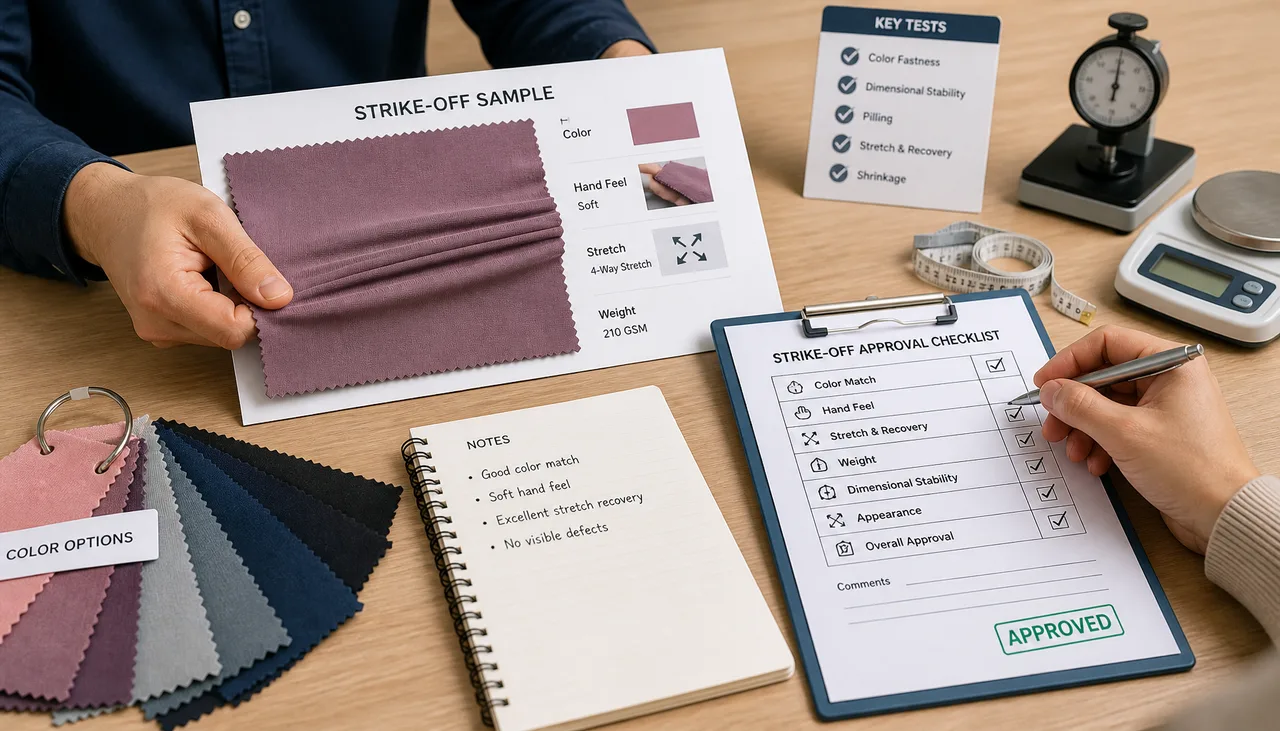
The supplier should identify every submission with information that links it to the order. At minimum, the approval package should record:
- buyer style or project reference;
- supplier fabric code and base-fabric specification;
- artwork file name, version, repeat size, and orientation for printed designs;
- color reference and viewing conditions;
- submission number and date;
- proposed finish and any optional treatment;
- physical sample location or courier reference;
- approver's name, decision, date, and written comments.
Use one status for each submission: approved, approved with stated conditions, or rejected with correction instructions. Avoid comments such as “close,” “almost right,” or “proceed carefully,” because they do not define whether the supplier is authorized to continue.
Define acceptance criteria before the sample is produced
The approval criteria should match the type of submission. For a printed strike-off, buyers may need to confirm:
- print colors against the named reference under an agreed light source;
- artwork scale, repeat, direction, and placement;
- registration between colors and sharpness of printed details;
- strike-through, surface coverage, and appearance when the fabric is extended;
- hand-feel change caused by ink, binder, curing, or another print process;
- whether the submitted base fabric matches the intended construction.
If instrumental color measurement is required, identify the instrument conditions, specimen preparation, color-difference formula, and tolerance in the agreement. There is no responsible universal ΔE limit for every fabric, shade, customer, and end use.
For stretch activewear, inspect the print both relaxed and at the extension expected in the garment zone. A print that appears continuous on a table may show white grinning, cracking, distortion, or loss of detail when used across a seat, thigh, waistband, or sports-bra panel.
Separate visual approval from fabric-performance approval
A strike-off is usually too small to establish every bulk-performance result. Keep a separate checklist for the finished fabric specification, including the requirements relevant to the product:
- composition, knit construction, finished GSM, and usable width;
- stretch and recovery by direction under defined conditions;
- dimensional stability and spirality after the agreed care cycle;
- colorfastness, pilling, abrasion, or snagging requirements;
- moisture-management or other functional claims, where applicable;
- bulk shade, print, and lot-consistency controls.
The contract should state which results are needed before bulk production, which can be checked on the first production lot, and what happens if the result falls outside the agreed tolerance.
Link the deposit to written commercial terms
Do not assume that a deposit is automatically refundable when a strike-off is rejected. Some suppliers require payment before development work begins; others charge a separate sampling fee or credit approved development costs against the order. The correct arrangement is the one recorded in the quotation, pro forma invoice, purchase order, or development agreement.
Before payment, confirm in writing:
- what the deposit pays for;
- whether strike-off or lab-dip costs are included;
- how many submissions or correction rounds are included;
- who pays for additional revisions, courier charges, screens, cylinders, artwork preparation, or other setup costs;
- whether any amount is refundable, non-refundable, or credited to bulk production;
- what happens if the buyer rejects the submission or changes the brief;
- whether material purchasing or production capacity is reserved before final approval;
- which written approval authorizes bulk production.
Illustrative approval-loop calculation
Assume a hypothetical program has three print colorways and the agreement includes an initial strike-off plus one correction for each colorway. The planned submission capacity is:
3 colorways × 2 submissions = 6 strike-off submissions
This is a planning example, not a ClothFactory commercial term. It shows why the number of colorways and included revision rounds should be written into the quotation before the deposit is paid.
Use a no-production-without-approval control
The safest workflow separates sample approval from bulk authorization:
- Buyer issues the confirmed artwork, color references, base-fabric specification, and acceptance criteria.
- Supplier acknowledges the submission scope, charges, timing, and revision terms.
- Supplier produces an identified strike-off, lab dip, or development sample.
- Buyer records an approval decision against that exact submission.
- Supplier confirms any conditions and the final approved reference.
- Buyer issues written authorization for bulk production according to the payment agreement.
- Supplier retains the approved reference for bulk comparison and quality control.
An email or approval form should state that silence, courier receipt, or payment alone does not constitute visual approval unless the commercial agreement explicitly says otherwise.
Red flags before paying a deposit
- The supplier cannot explain whether the approval item is a strike-off, lab dip, sample yardage, or bulk-lot sample.
- The quotation does not identify the base fabric, colorways, revision rounds, or setup charges.
- The supplier asks for “approval” without a submission code or physical reference.
- Print scale, repeat, stretch condition, and viewing light are left undefined.
- The deposit terms do not state whether development charges are refundable or creditable.
- Bulk production can begin without named written authorization.
- The supplier treats strike-off approval as proof of all fabric-performance requirements.
Procurement next step
Before paying, send the supplier a one-page approval matrix covering the sample type, base-fabric code, artwork version, color references, acceptance criteria, revision rounds, charges, decision authority, and bulk-release point. For a ClothFactory development request, also identify whether the project uses an existing nylon-spandex or polyester-spandex base fabric or requires a new construction; the strike-off should be evaluated on the same confirmed base fabric intended for production.