
There is no universal sample count for checking fabric stretch ratio. The selected test method determines the required laboratory specimens, while the buyer's sampling plan must separately cover the rolls, dye lots, fabric directions, and locations needed to represent the sourcing decision.
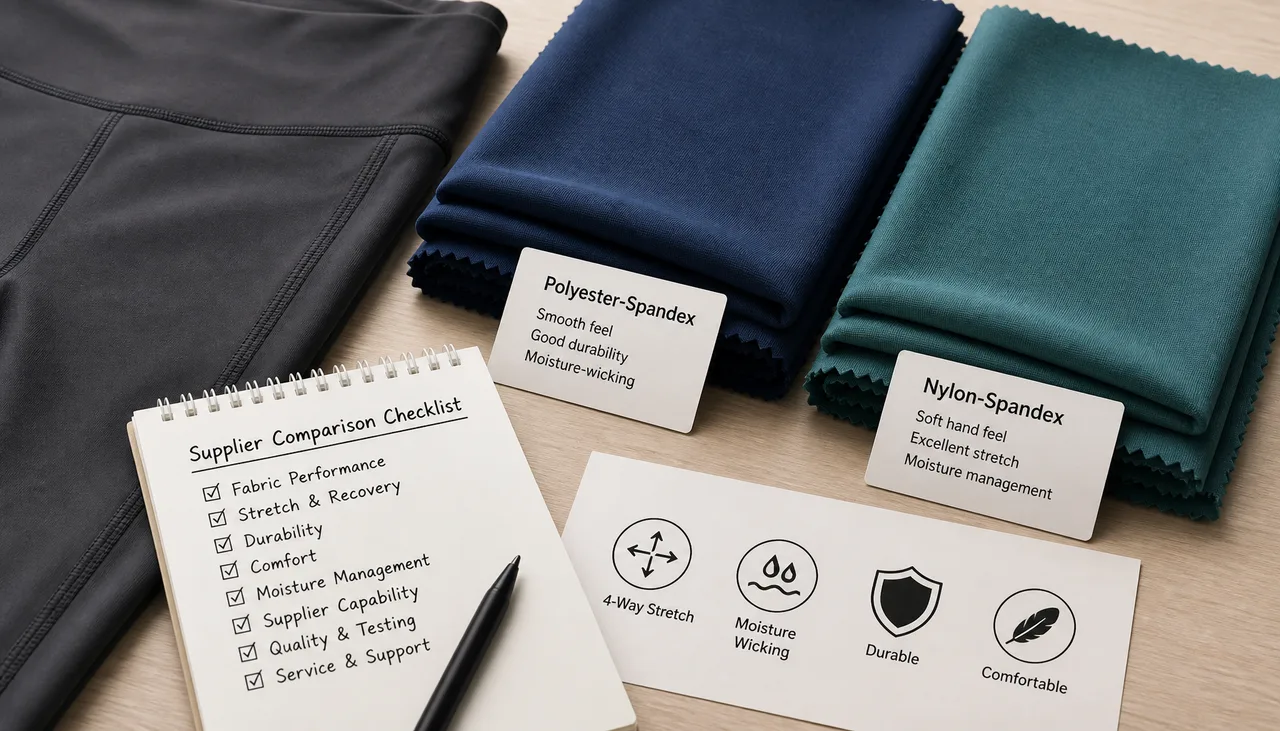
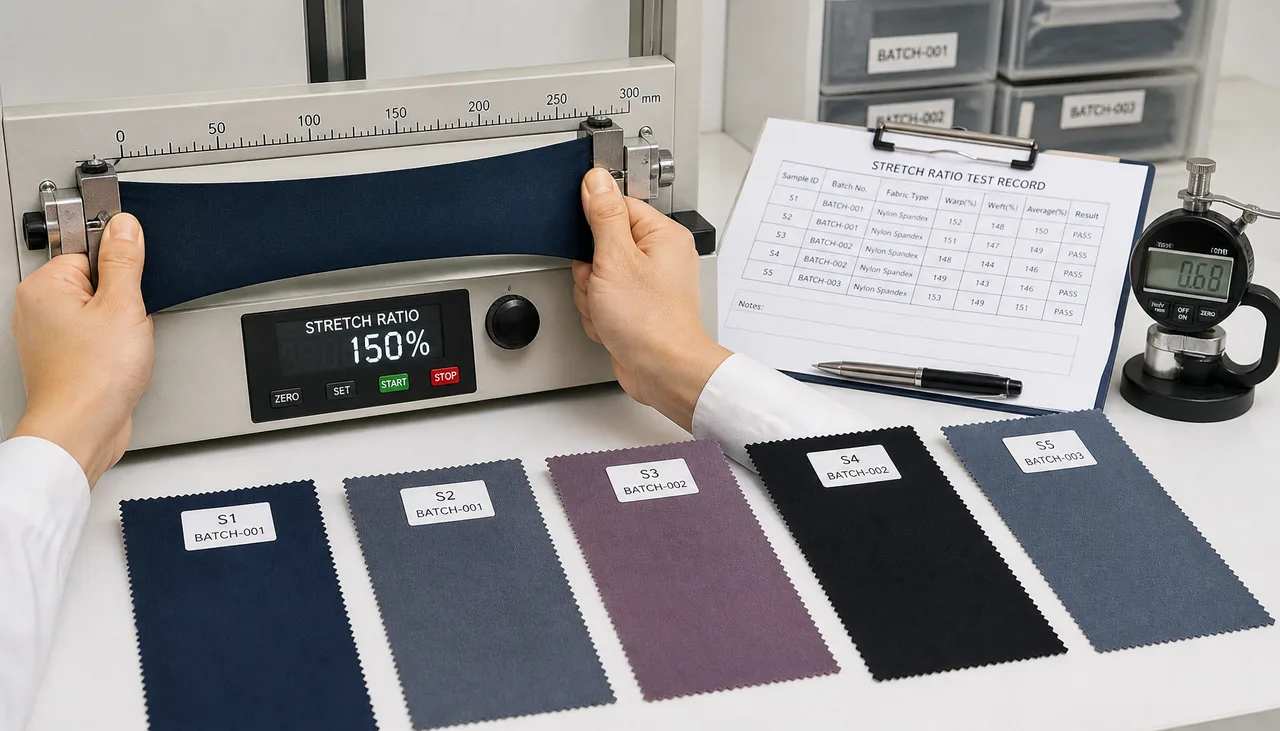
Define what “stretch ratio” means before sampling
Suppliers and buyers may use “stretch ratio,” “elongation,” and “stretch percentage” differently. The test request should define the calculation and reporting unit instead of relying on the phrase alone.
For percentage stretch:
Stretch (%) = (extended length − initial length) ÷ initial length × 100
Illustrative calculation — not a ClothFactory test result: a marked length that increases from 100 mm to 150 mm has:
(150 mm − 100 mm) ÷ 100 mm × 100 = 50% stretch
The same result could be described as an extended-length ratio of 1.5:1, so the report must state which convention it uses. It should also distinguish maximum extension from force at a specified extension, recovery after release, and residual growth. These values answer different procurement questions.
Separate laboratory specimens from production coverage
Stretch testing involves several sampling levels:
- Production lot: the quantity covered by one acceptance decision.
- Rolls or production groups: represent dye lots, knitting positions, finishing groups, dates, or other traceable sources.
- Locations within a roll: reveal variation along the roll length or across its usable width.
- Fabric directions: normally require separate evaluation because coursewise and lengthwise behavior can differ.
- Test specimens: pieces prepared and measured according to the selected method.
Several specimens cut beside each other improve repeatability for that sampled location, but they do not demonstrate consistency across multiple rolls. Ten specimens from one roll still represent one roll.
Let the test method set the specimen count
Stretch methods differ in specimen dimensions, gauge length, load or force, extension rate, cycling, hold time, recovery time, and calculation. Select the method first, then complete its required specimen set for every sampling group in the buyer's plan.
The report should state:
- method identifier and edition;
- specimen count and direction;
- conditioning and relaxation procedure;
- gauge length and specimen dimensions;
- applied load or target extension;
- extension rate, hold time, and number of cycles;
- recovery interval and residual-growth calculation;
- pre-wash or post-wash condition;
- individual results, average, range, and specimen origin.
Do not divide one method-required specimen set among unrelated rolls unless the method and purchase agreement explicitly permit that design.
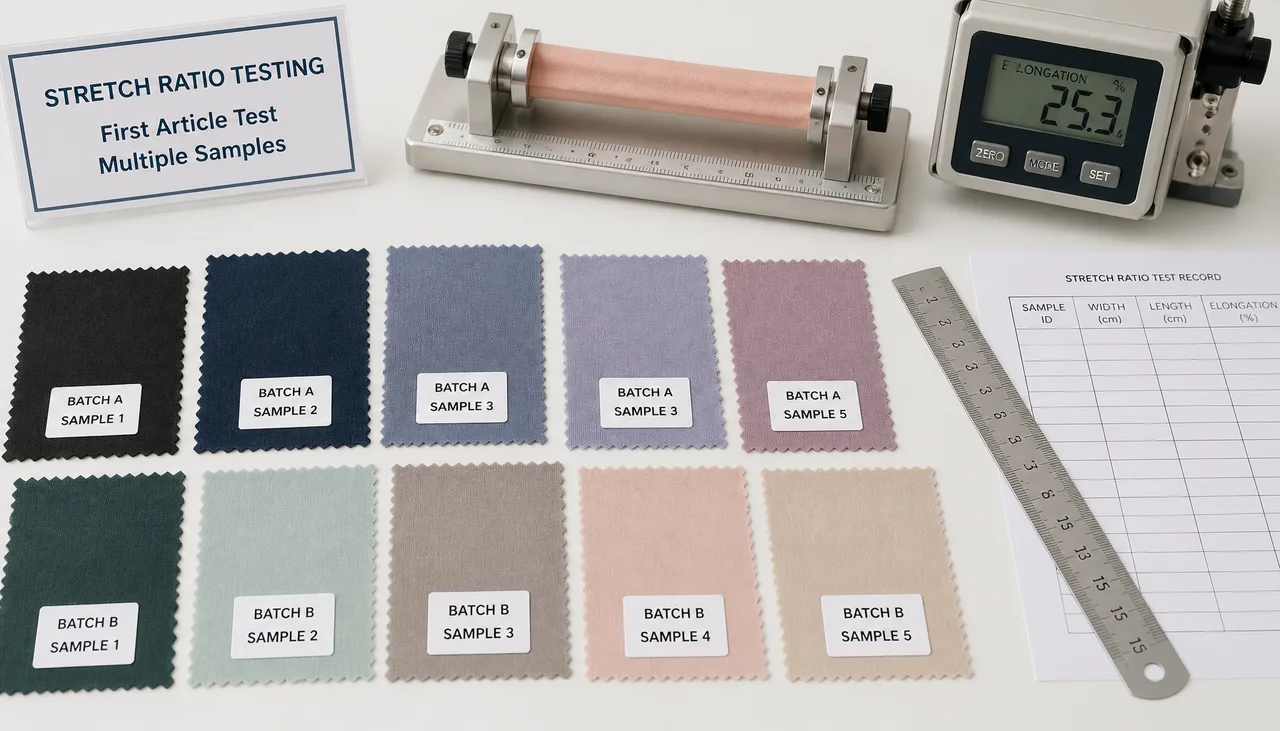
Adjust production coverage to the sourcing stage
| Stage | Decision being made | Appropriate sampling logic |
|---|---|---|
| Candidate screening | Is this construction worth developing? | Test one complete method-required set from each candidate under identical conditions. Results represent only the submitted samples. |
| Finished-fabric development | Did dyeing, heat setting, or another finish change the response? | Test complete sets from matched, identified material before and after the relevant process or wash condition. |
| Pre-production confirmation | Is the approved construction reproducible? | Cover more than one identified production position or roll where available, with complete sets for each sampling group. |
| Bulk-lot acceptance | Can the shipment be released? | Select rolls across each defined dye lot or production group using a written contractual or risk-based plan. |
The plan should state how to handle an outlying roll or group. Options may include adjacent resampling, expanded roll coverage, investigation, segregation, reprocessing, or rejection. A passing overall average should not automatically release a roll with unacceptable recovery or force behavior.
Use an illustrative sampling calculation correctly
The following is a hypothetical buyer-defined plan, not an industry standard or ClothFactory test result. Suppose a buyer selects four representative rolls and samples two locations per roll:
4 rolls × 2 locations = 8 sampling groups
If both principal directions are evaluated separately:
8 sampling groups × 2 directions = 16 direction-specific groups
Each group must then supply the complete number of specimens required by the selected method. If that number is n, the total is:
16 direction-specific groups × n method-required specimens
The correct number of rolls depends on lot size, dye-lot structure, color and finish groups, earlier quality history, construction risk, and the purchase agreement. The example shows the calculation logic, not a default requirement.
Measure more than maximum stretch
Maximum elongation alone does not show whether a fabric will provide support or maintain fit. For leggings, sports bras, underwear, or shapewear, buyers may also need:
- force at the extension expected in the garment;
- recovery after a defined hold and relaxation period;
- residual growth after repeated cycling;
- results after the intended wash and drying procedure;
- appearance, cover, or print integrity under an agreed extension.
Spandex percentage is not a substitute for these measurements. Yarn size, knit geometry, spandex feeding, heat setting, finishing, and specimen direction all influence the result.
Keep every comparison condition consistent
Stretch results are comparable only when the conditions match. Use the same specimen direction, dimensions, conditioning, gauge length, load or extension, rate, cycles, hold time, recovery interval, and laundering condition across candidates.
Record the exact fabric code, color, finish, roll, dye lot, and sampling location. Test the finished construction rather than relying only on greige fabric or an unfinished development swatch. Dark colors, special finishes, or different heat-setting conditions may need separate confirmation when they create a different production risk.
Interpret variation before averaging
Review individual and group results, not only the mean. A wide range can indicate variation by roll, direction, location, finish, or test preparation. Investigate that source before adding more results to an average.
Retesting adjacent material can help determine whether an unusual result is local or representative, but the original result should remain in the record. The purchase agreement should define whether acceptance applies to each roll, each production group, or the lot as a whole.
Information buyers should include in the request
Provide the supplier or laboratory with:
- fabric code, composition, knit construction, finished GSM, and usable width;
- intended garment, body zone, fit, and expected extension;
- selected test method and reporting convention;
- specimen directions and production sampling locations;
- conditioning, cycling, hold, recovery, and wash requirements;
- required force, stretch, recovery, or growth limits;
- lot definition and roll-selection rule;
- report format showing individual results and full traceability.
Procurement next step
Choose the stretch method and reporting convention first. Then build a separate production sampling plan that covers the rolls, dye lots, directions, and locations relevant to the order. ClothFactory can prepare identified nylon-spandex or polyester-spandex specimens, but the buyer and supplier should agree the method, sampling coverage, garment extension, recovery interval, and acceptance limits before using the results for bulk approval.