
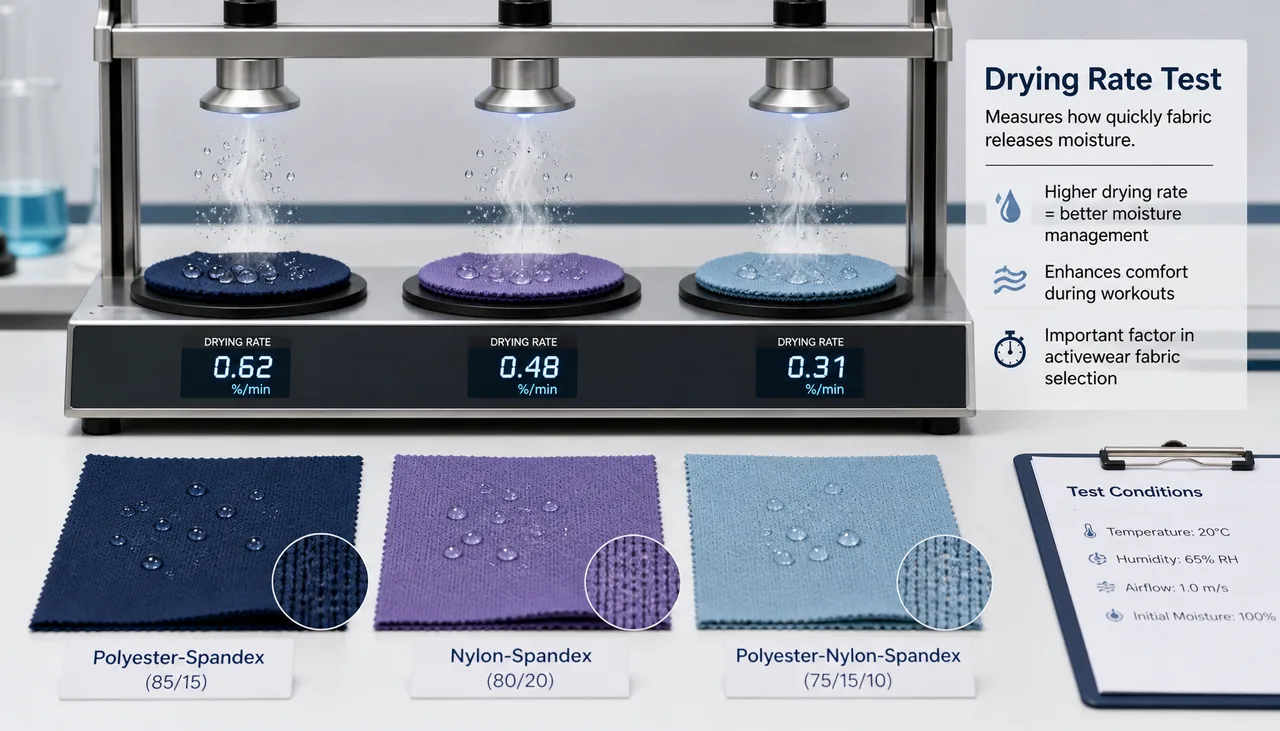
A drying-rate result is meaningful only when the test method, water dose, specimen size, conditioning, airflow, temperature, humidity and endpoint are known. Buyers should compare fabrics tested under the same procedure and interpret drying together with wet pickup, spreading, garment construction and intended climate rather than treating one short drying time as proof of comfort.
Identify What the Test Measures
Some procedures track mass loss over time, while others report the time required to reach a defined residual moisture level. A result expressed in minutes cannot be compared with a rate expressed as mass per area per time without the underlying data and calculation. Ask the laboratory to state the endpoint because “dry” may mean a balance reading, a percentage of initial moisture or another defined condition. Liquid-moisture and drying behavior are separate properties; a method such as AATCC 195 does not replace a drying-rate test.
Control the Comparison Variables
Specimen area, applied water, fabric mass and exposed surface can change the apparent result. Air movement and environmental conditions are especially influential. Require candidates to be conditioned and tested together where possible, using the same face orientation and number of replicates. If samples differ in GSM or construction, report those differences because the drying result may reflect stored water quantity as much as fiber chemistry. Air permeability, if relevant, should be measured by ISO 9237 or ASTM D737 rather than inferred from drying time.
Read the Curve, Not Only the Endpoint
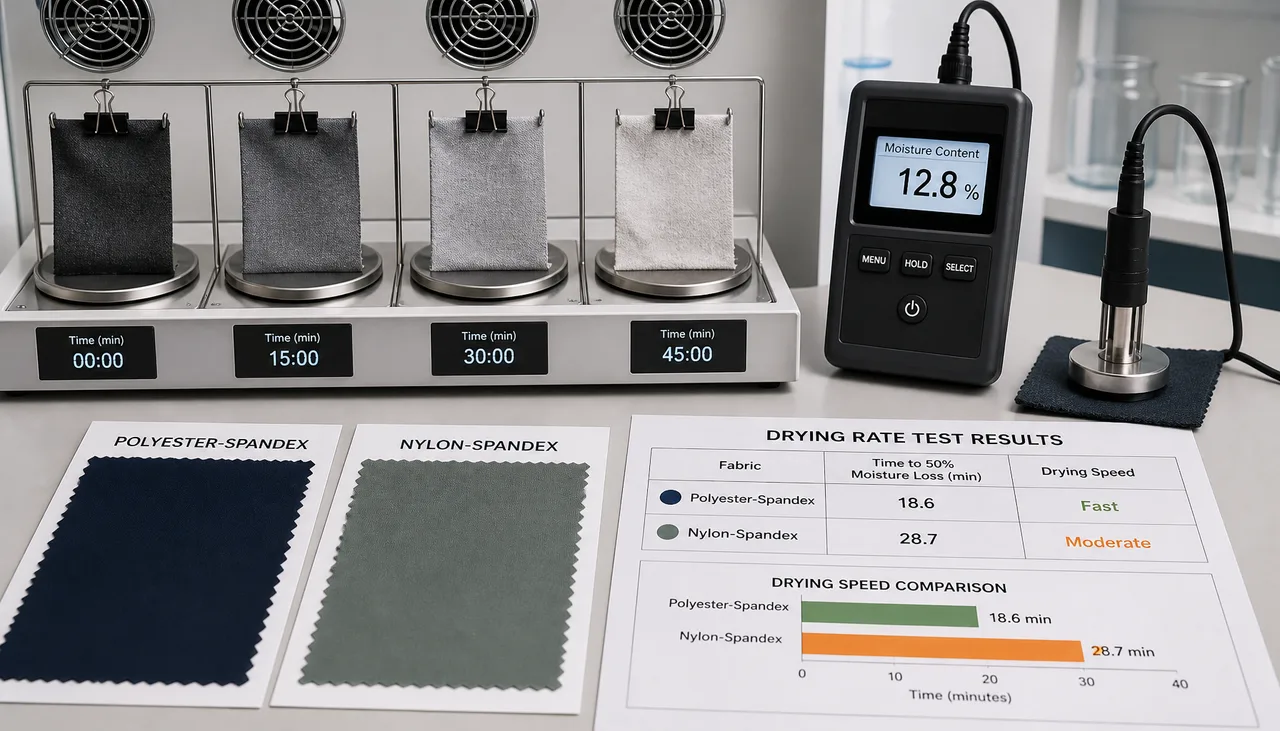
If the laboratory supplies time-series mass data, review how quickly moisture leaves during the early and late stages. An illustrative calculation uses drying rate = change in water mass ÷ exposed area ÷ elapsed time. The result remains valid only for the stated interval and conditions; it should not be presented as a universal garment value or as ClothFactory product data unless it came from a verified report for that product.
Connect Fabric Data to Wear
A fast laboratory endpoint does not automatically mean lower skin wetness. Liquid spreading can enlarge the evaporation area, but it can also increase the visibly wet zone. A garment’s fit, layering, ventilation and sweat load change performance. For running shirts, compare fabric results with a sewn wear or simulated-use trial and document whether the fabric clings, darkens, cools or recovers acceptably after wetting. Supplier reports are easier to compare with the checks in comparing supplier reports for moisture management.
Buyer Risk Check
- Do not compare results from different methods or environments.
- Do not infer wicking from drying time alone.
- Check whether optional finishes were tested before or after laundering.
- Request replicate results, not only the most favorable specimen.
- Confirm units and calculations in the original report.
- Avoid “quick-dry” claims without a product-specific acceptance basis.
Approval Requirement
Write the test method, conditioning, laundering state and acceptance rule into the specification before comparing candidates. ClothFactory can help prepare representative fabric samples through the contact page, but the buyer should retain the full report and connect it to the exact quality, color and finish. Reconfirm the result when a finishing route or construction changes because prior data may no longer represent the bulk material.