
Spirality and skew results indicate structural distortion, but buyers should interpret them only with the test method, specimen orientation, laundering procedure, measurement formula and garment construction. A single percentage does not establish acceptability: the commercial risk is whether side seams, prints, hems or panel lines move beyond the tolerance defined for the finished style.
Distinguish the Two Conditions
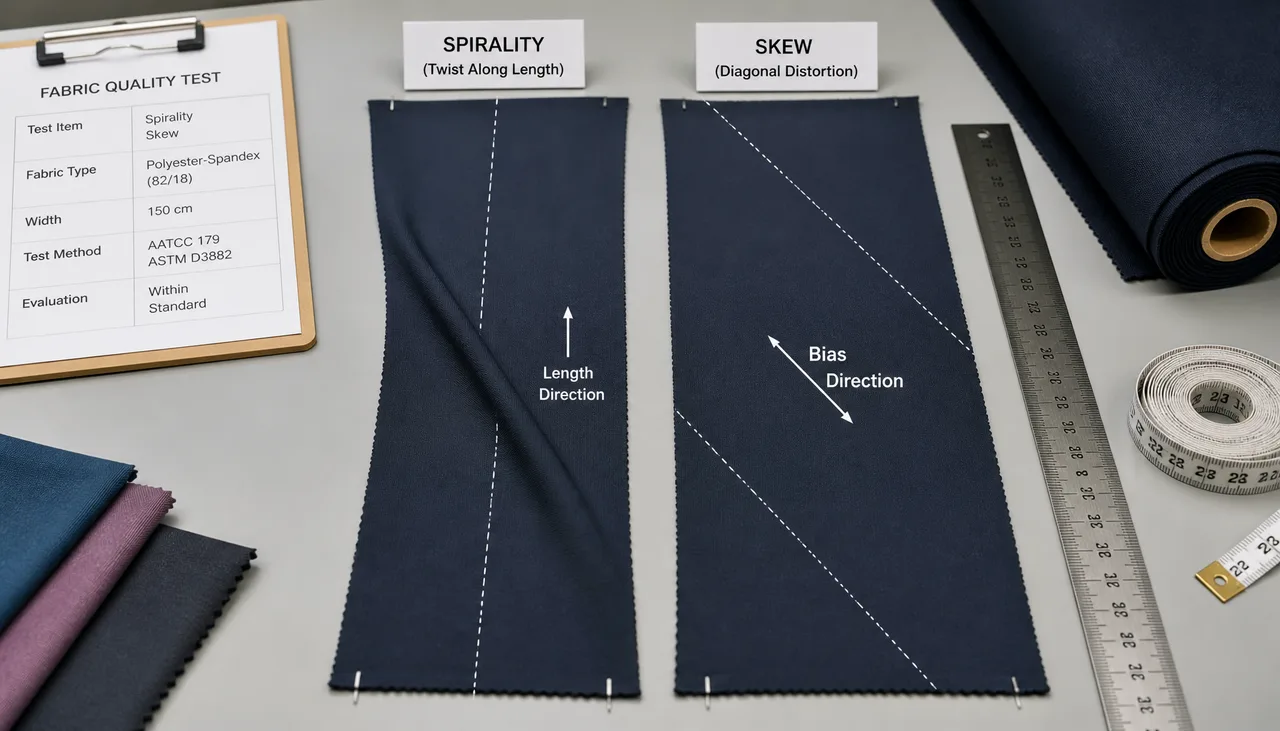
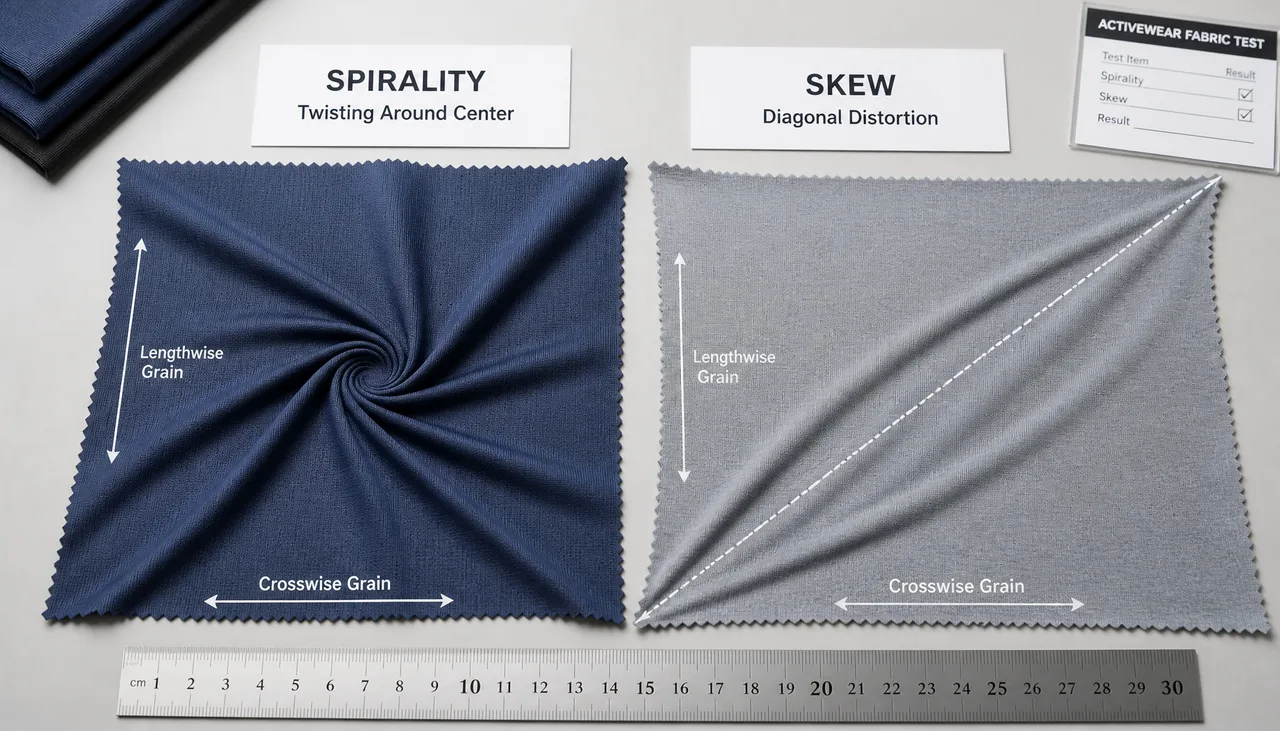
Skew describes courses or design lines displaced from their intended alignment, while spirality describes twisting that becomes especially visible when a tubular or cut garment no longer hangs straight. Laboratories and factories may use these terms differently, so the report must state the measurement geometry and calculation. Do not compare values from different definitions simply because both are expressed as percentages. The ISO 16322 series defines methods for determining spirality after laundering; confirm which part and edition the laboratory used.
Check the Test State
Record whether the specimen is tested before washing, after one care cycle or after several cycles, and whether it is relaxed, conditioned, tumble dried or line dried. Heat, moisture and mechanical action can release knitting and finishing stresses. A satisfactory unwashed result can therefore coexist with visible garment twisting after care, making the laundering procedure central to interpretation.
Convert the Result Into Garment Risk
Map the fabric direction onto the pattern. A fitted legging with long side seams, a striped polo and a panelled sports bra do not have equal sensitivity to the same distortion. Cut and wash a prototype using the planned grain direction, seam type and panel geometry. For the related change in stretch ratio after washing, see comparing stretch ratio before and after washing. Check seam migration, leg or body twist, asymmetric hems and print alignment rather than treating the fabric percentage as the final product decision.
Use a Clear Measurement Record
An illustrative calculation may express displacement as measured offset divided by the relevant specimen dimension, multiplied by 100. That formula is not universal; use only the calculation specified by the agreed method. The report should include original dimensions, marked reference lines, measured displacement, individual specimen results and photographs so that the conclusion can be audited.
Buyer Risk Check
- Do not combine skew and spirality into one undefined value.
- Do not compare washed and unwashed specimens.
- Verify face, direction and specimen orientation.
- Review individual results instead of only an average.
- Repeat evaluation after a change in knitting, heat setting or finishing.
- Confirm the fabric result with the intended garment pattern.
Approval Requirement
Define the test method, care cycle, specimen count and garment acceptance criteria before requesting data. ClothFactory can provide traceable material for the agreed evaluation, but the buyer should retain marked specimens, reports and the approved prototype. If the bulk finishing route changes, repeat the relevant checks because structural stress and post-wash alignment may also change. Share the intended garment construction with ClothFactory through the contact page before sampling.