
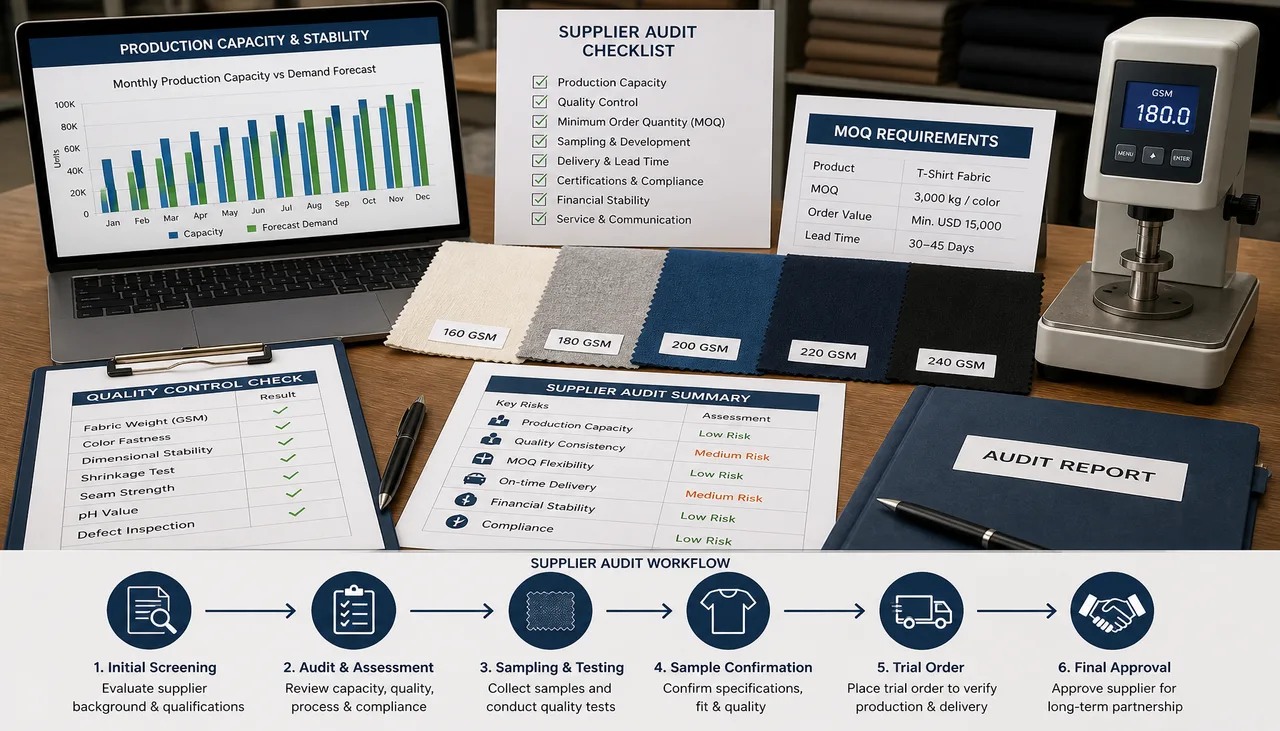
A supplier capability audit should test whether the actual supply route can reproduce the approved fabric, detect variation and respond before a defect reaches garment cutting. Buyers should focus on traceability, process control, subcontractor oversight, test capability, capacity evidence and corrective action rather than treating certificates, showroom samples or stated monthly capacity as sufficient proof.
Scope Mismatch
Confirm which legal entity, location and production processes the audit covers. A report for one facility does not automatically cover knitting, dyeing, finishing, printing or inspection performed elsewhere. Map the proposed product route and identify who owns each control point. The risk is not subcontracting itself; it is an unrecorded handoff where specifications, lot identity or corrective actions can be lost. The effect on sampling and bulk planning is covered in how a supplier capability audit affects fabric sampling and bulk planning.
Unsupported Capacity
Compare claimed capacity with machinery or partner allocation, working pattern, current loading, historical output and the requested construction. Total factory volume may not represent capacity available for a specific gauge, dye route or finish. Ask how production slots are reserved and what constraint controls delivery. Capacity should be evaluated for the proposed order and period, not accepted as a permanent headline number.
Weak Specification Control
Review how the supplier converts a buyer requirement into yarn, construction, color, finish, test and inspection instructions. Check revision control, approval signatures and how obsolete versions are removed from use. If operators or subcontractors rely on informal messages, a later correction may not reach every process, creating bulk fabric that matches an earlier specification instead of the final approved sample.

Inadequate Test and Inspection Evidence
Confirm which tests are performed internally, which are outsourced, how equipment is controlled and how results link to a lot or roll. Review actual records for GSM, usable width, shade, defects and application-specific properties. A checklist marked “pass” without method, unit, sampling frequency or result does not show process capability and cannot support a buyer’s later claim investigation.
Poor Nonconformance Control
Ask for recent examples showing identification, segregation, root-cause analysis, disposition and effectiveness review. The supplier should explain who can authorize use under concession and how affected customers are informed. Repeated defects with different superficial explanations indicate that corrective action is closing paperwork rather than controlling the production cause.
Audit Evidence Table
| Risk | Evidence to inspect | Warning sign |
|---|---|---|
| Traceability | Lot and roll records | Manual relabeling without history |
| Capacity | Schedule and output records | Unsupported monthly total |
| Specifications | Controlled revisions | Instructions stored in chat only |
| Testing | Raw results and methods | Pass/fail without data |
| Subcontracting | Approved route and responsibilities | Undisclosed process location |
| Corrective action | Closed cases and verification | Repeated issue without prevention |
Audit Conclusion
Rate each risk against the intended product, then assign corrective actions, owners and deadlines before bulk approval. ClothFactory or any competing supplier should be approved only for the evaluated product and process scope; request the audit scope through the contact page. Reassessment is appropriate when production location, construction, critical yarn, dyeing route or finishing method changes, because the original audit evidence may no longer represent the order. Use the verification points in what buyers should verify in a nylon-spandex manufacturer to close the gaps.