
Polyester fiber is generally dimensionally stable under ordinary care, but a polyester or polyester-spandex garment can still shrink, grow or distort because of knit relaxation, heat setting, finishing, elastane behavior and laundering conditions. Apparel buyers should approve dimensional change on the finished fabric and garment under the intended care method instead of relying on fiber content alone. This guidance applies to knitted polyester and polyester-spandex apparel fabrics; woven or industrial polyester products may follow different care and test routes.
Fiber Stability Is Not Garment Stability
Polyester absorbs relatively little water compared with many natural fibers, so water-induced fiber swelling is not usually the main source of dimensional change. Knitted loops can still relax after tension from knitting, dyeing or finishing is released. A fabric may become shorter and wider, narrower and longer, or skewed rather than shrinking uniformly in both directions.
Heat Changes the Risk
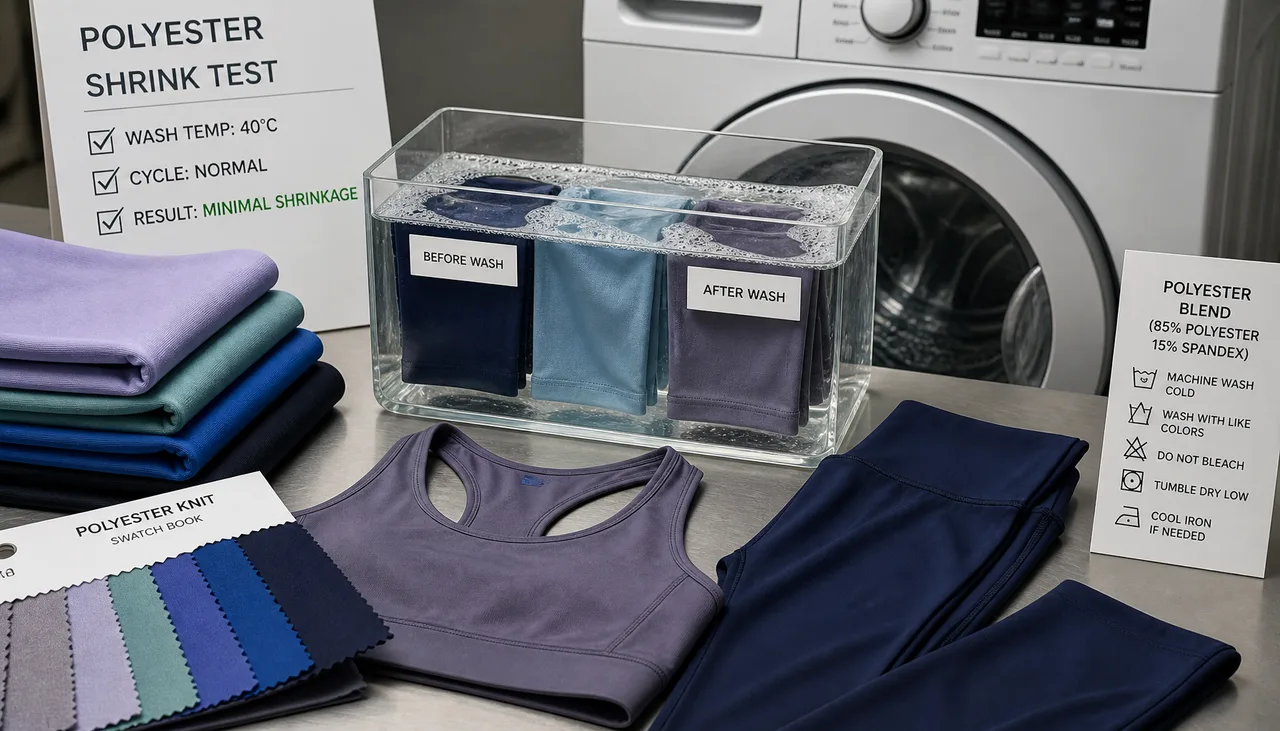
High washing or drying temperatures can alter dimensions, surface appearance and elastane performance, especially when care conditions exceed those used to stabilize the fabric. Do not describe all polyester as heat-proof. Record water temperature, cycle, detergent, load, drying method and number of cycles in the approval procedure, then use the same conditions when comparing development and bulk samples.
Construction and Finish Matter
Stitch density, yarn type, fabric weight, elastane, brushing and chemical finishing influence relaxation and recovery. Polyester blended with cotton, viscose or another fiber can also reflect the dimensional behavior of that component. A result from plain polyester jersey should not be transferred to a brushed polyester-spandex interlock merely because polyester is the largest percentage in both.
Measure Directional Change
Mark and measure specimens before and after the defined care procedure. An illustrative calculation is dimensional change (%) = (after-care dimension − initial dimension) ÷ initial dimension × 100. A negative value indicates shrinkage under that convention and a positive value indicates growth. The report should state the convention because some laboratories reverse the sign or report shrinkage as an unsigned value. Common laboratory routes use ISO 6330 for domestic washing and drying procedures and ISO 3759 for preparing, marking and measuring specimens; the buyer must still agree the cycle and acceptance value. For a like-for-like comparison, see how buyers can compare supplier reports for dimensional shrinkage.
Validate the Finished Garment
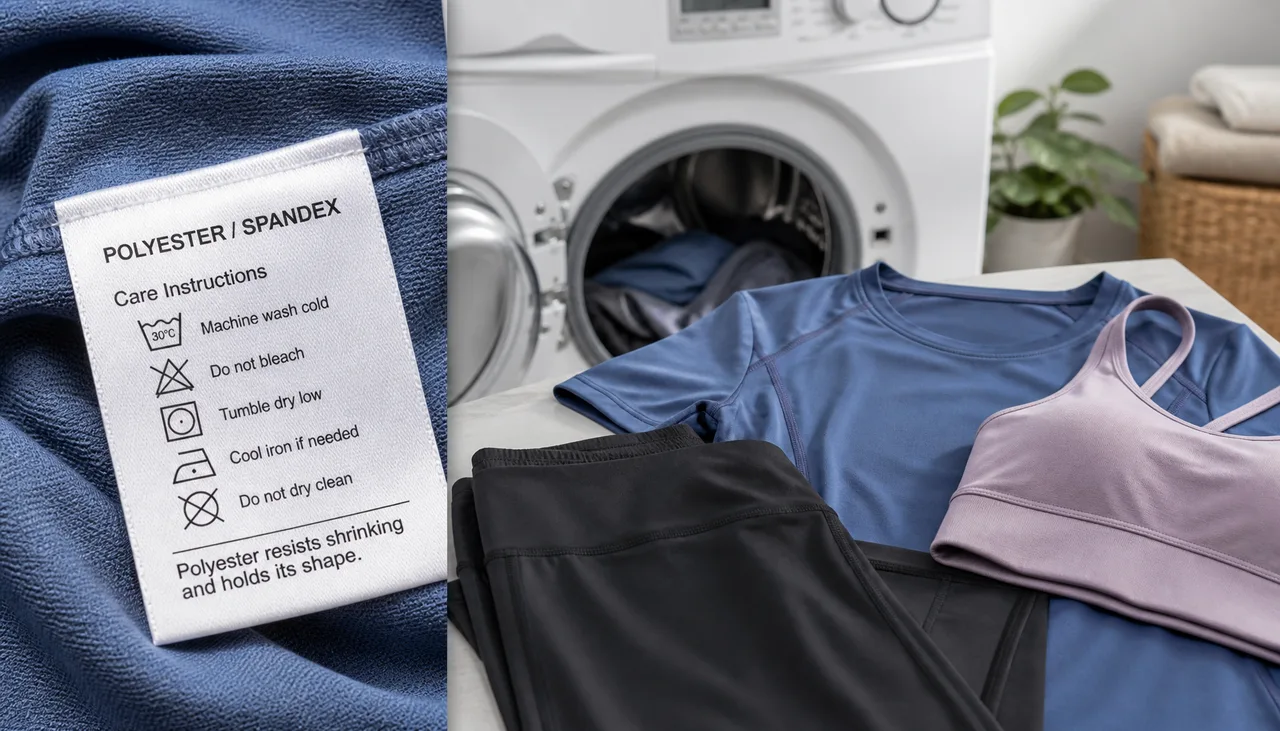
Fabric data cannot fully predict garment response where seams, rib trims, elastic, prints or mixed panels restrict movement. Wash a production-representative sample and measure key points such as body length, chest width, sleeve, waistband and inseam. Inspect twisting, seam puckering and differential shrinkage in addition to size change. Repeat the review after any material or care-label revision.
Buyer Risk Check
- Do not approve “preshrunk” without a defined test result.
- Do not compare results from different care procedures.
- Check length and width separately.
- Record growth and distortion, not only shrinkage.
- Test the intended color and finish when processing differs.
- Keep the approved fabric and garment reports with the bulk specification.
Procurement Requirement
Give ClothFactory the target construction, composition, GSM, usable width, finish and intended care method through the contact page when requesting samples. Define acceptable dimensional change for the garment rather than applying a universal polyester limit. The final care label and bulk release should be supported by results from the production-representative fabric and sewn product.