
Fabric for a tennis dress must balance movement, coverage, moisture handling, shape retention and skirt drape within one garment. Buyers should specify the bodice and skirt zones separately when their strain and coverage needs differ, then validate the selected fabric in a sewn prototype under the intended movement and care conditions.
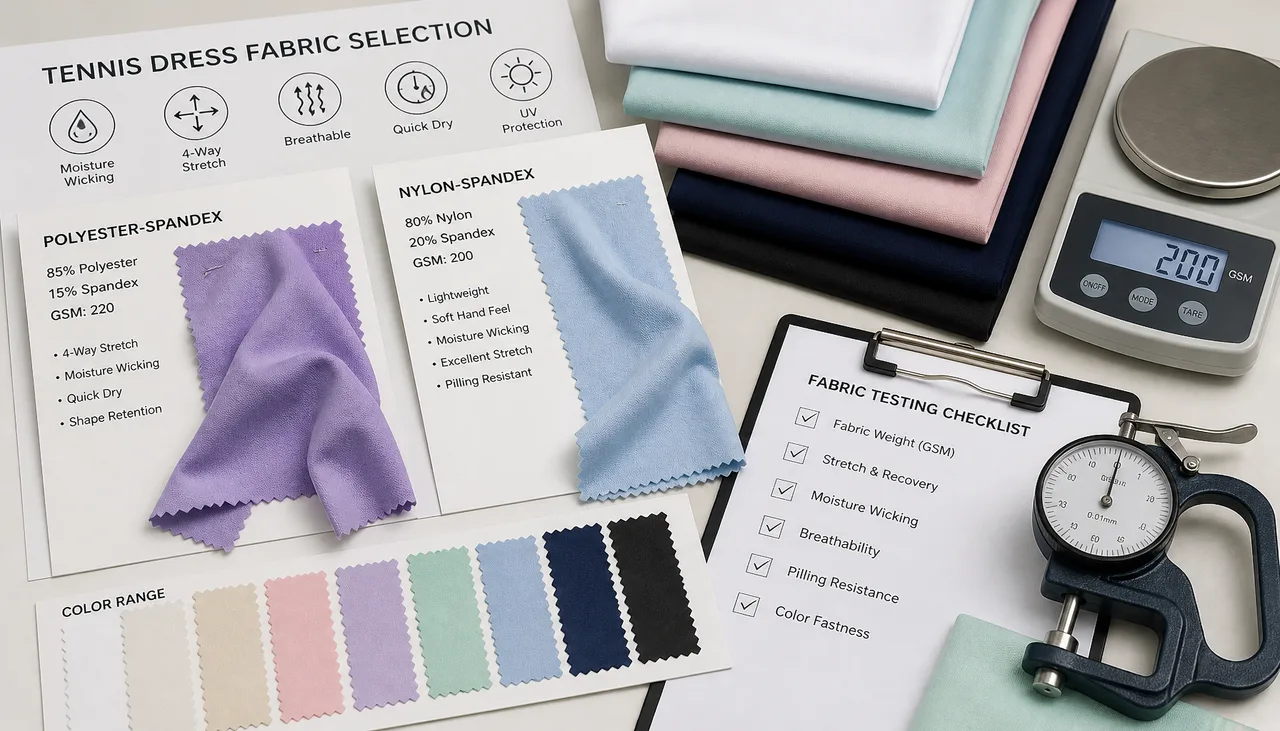
Map the Garment Zones
The upper body may need secure recovery and low wet cling, while the skirt may need lighter drape and freedom from excessive static or curl. Integrated shorts introduce another requirement for opacity and recovery under higher extension. State whether one fabric must serve every zone or whether coordinated qualities are acceptable. This decision affects testing, color matching, sewing and material consumption before style details are added. Common development delays are summarized in which fabric problems most often delay tennis-dress development.
Define Stretch and Recovery Conditions
Specify required stretch direction based on pattern orientation and body movement, then agree on the method, extension level, holding time and recovery interval. A high stretch percentage is not enough if the material grows after repeated movement. Evaluate the prototype through lunges, lateral steps and seated positions, and check whether the waist, armhole and skirt return without rippling or permanent deformation.
Balance GSM, Drape and Coverage
GSM provides weight per area but does not independently define opacity or support. Construction, yarn, color and finishing also influence coverage. For an illustrative comparison, two fabrics at the same GSM can show different visibility when stretched because one opens more between stitches. Review light and dark colorways at garment-level strain and under realistic lighting before approving a range.
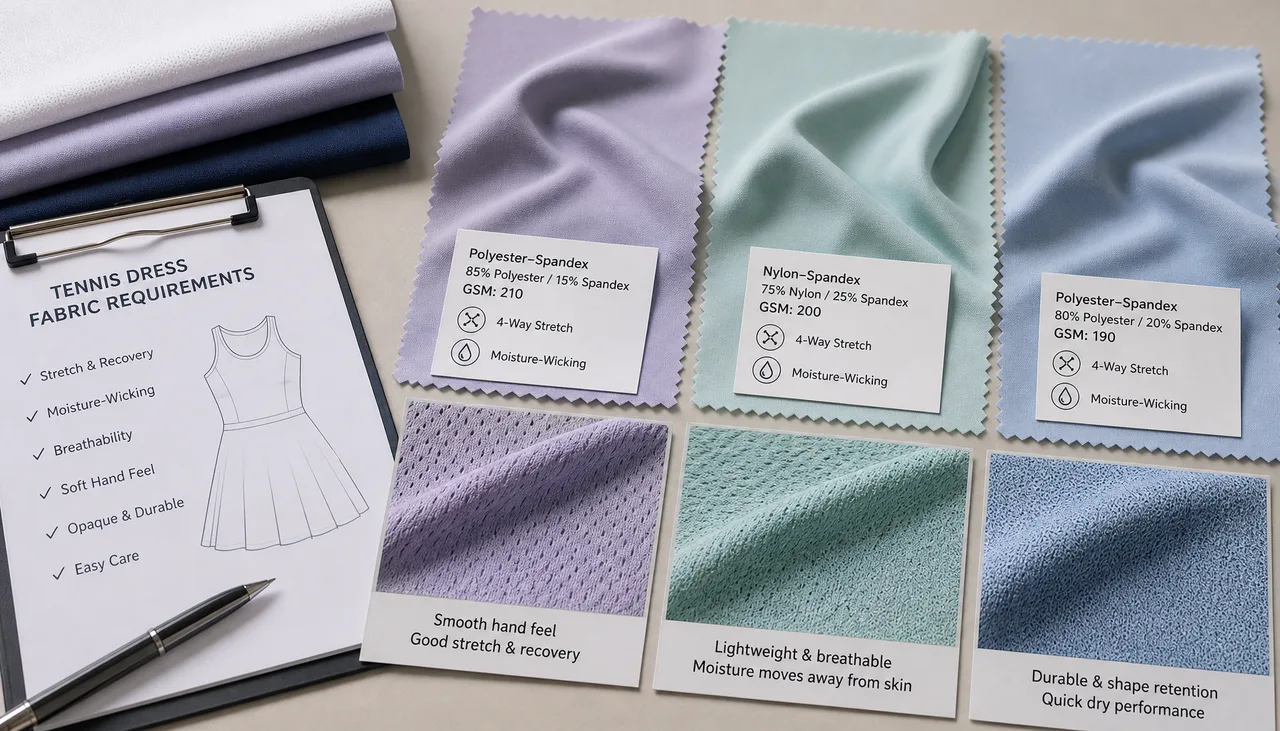
Set Moisture and Care Requirements
Decide whether the project needs liquid spreading, drying rate, air permeability or another specific measure; “breathable” cannot replace a test requirement. Define the washing and drying sequence used for dimensional stability, appearance and functional-finish durability. Outdoor use may also require a separately verified UV-protection target, but fiber composition or dark color alone should not be used as proof. Name the UV method, such as AS/NZS 4399 or AATCC 183, when a claim is required.
Check Construction Compatibility
Sew the fabric with the planned seams, elastic, zipper, binding and hem. Inspect needle damage, seam grin, puckering, skipped stitches and edge curl, then repeat the review after laundering. If the dress combines two fabrics, verify shade compatibility and differential shrinkage. A small difference in dimensional change can twist seams or create a wavy junction after care.
Tennis-Dress Specification Brief
- Garment zones and whether each uses the same quality
- Composition, knit structure, target GSM and usable width
- Stretch and recovery requirements by direction
- Coverage condition and color range
- Drape and hand-feel reference
- Moisture, durability and colorfastness tests
- Care method and dimensional-stability limits
- Prototype movement and fit checks
Sampling Decision
Send ClothFactory the pattern concept, zone map, target measurements, color standard and required tests through the contact page. Compare candidates under the same conditions and record why one advances to garment sampling. Bulk approval should be based on a written specification plus a retained physical reference, not on the assumption that any nylon-spandex or polyester-spandex knit will perform the same way.